

Lift Innovation Universal, LLC works with proven manufacturing partners to provide reliable sucker rod products, polished rods, pony rods, sinker bars, and couplings for North American oilfield customers. Through our partnership with Shandong Shouguang Kunlong Petroleum Machinery Co., Ltd., LIU combines U.S.-based communication and support with established petroleum equipment manufacturing capability.
Kunlong is an API-certified petroleum equipment manufacturer with more than 20 years of experience in oilfield product development, manufacturing, quality control, and field applications. This partnership allows LIU to offer dependable supply, competitive pricing, and scalable delivery for operators, distributors, and service companies.
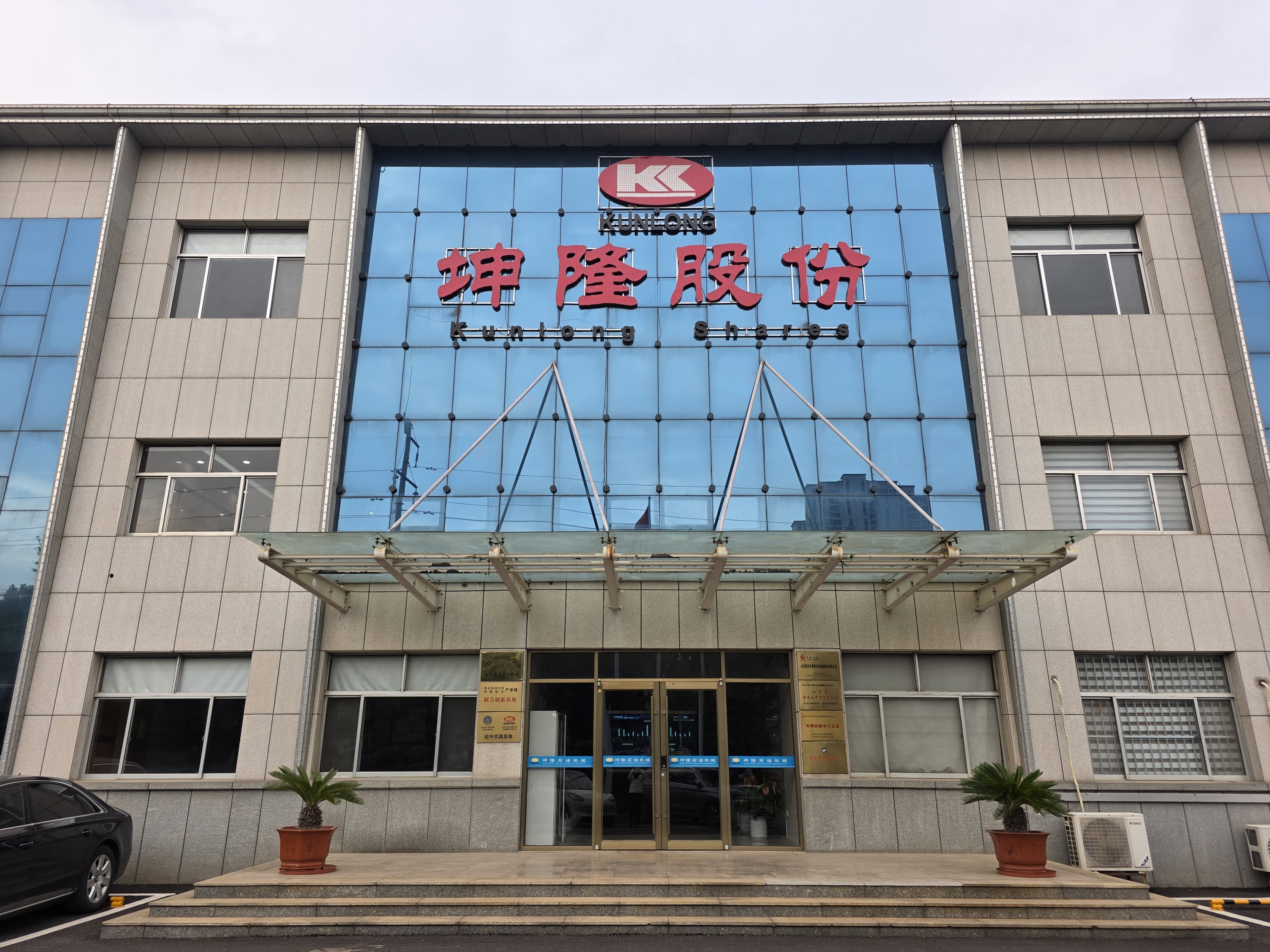
Established Manufacturing Base: Kunlong has been focused on petroleum equipment manufacturing, product development, and oilfield support services since 2002.
API-Certified Supply: The manufacturing facility holds API certifications supporting sucker rods, polished rods, pony rods, sinker bars, couplings, pumps, and related oilfield products.
Advanced Production Lines: Automated CNC machining, forging, coating, coupling processing, and anti-corrosion production lines help ensure consistency, efficiency, and reliable product quality.
U.S. Market Support: LIU provides local communication, customer service, sourcing coordination, and supply support for customers across North America.
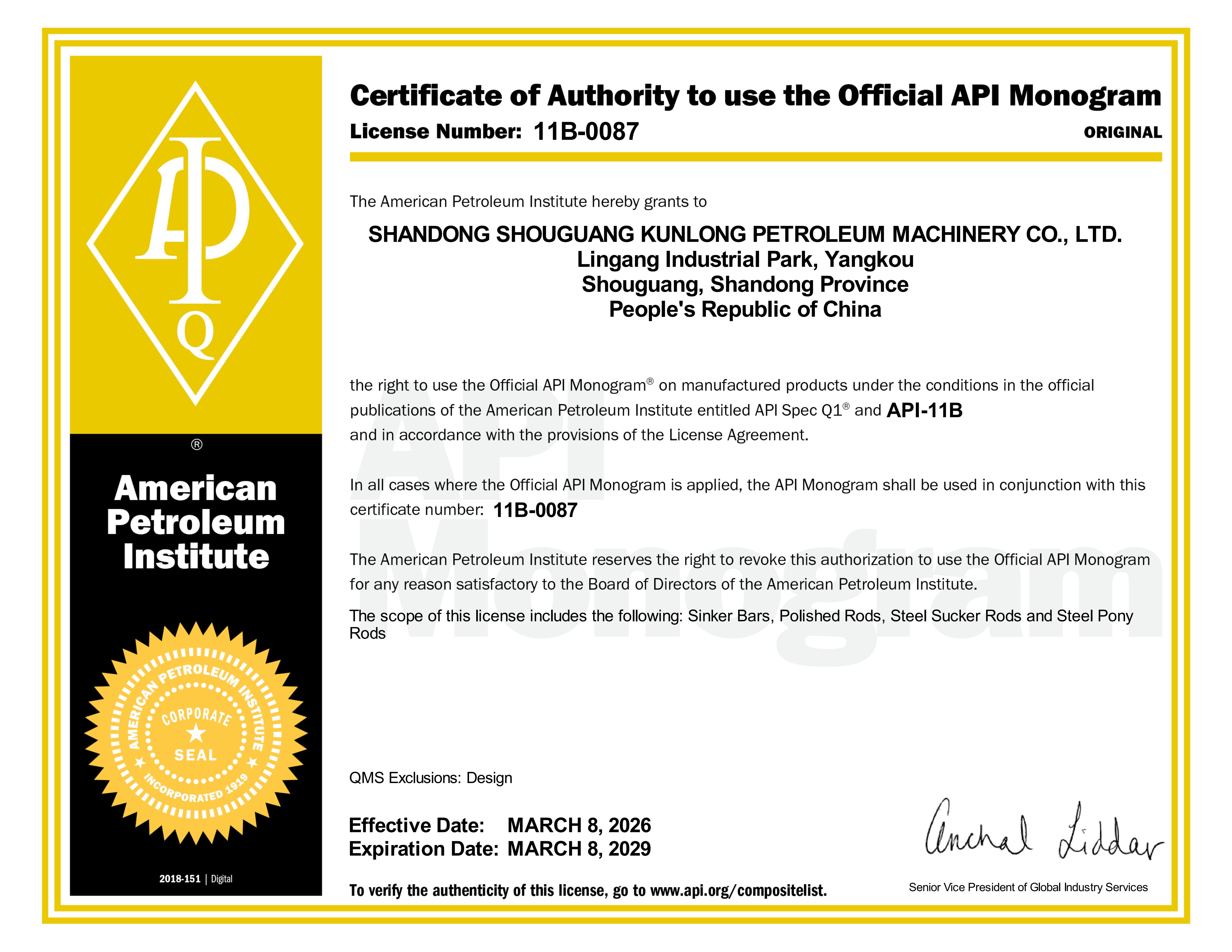
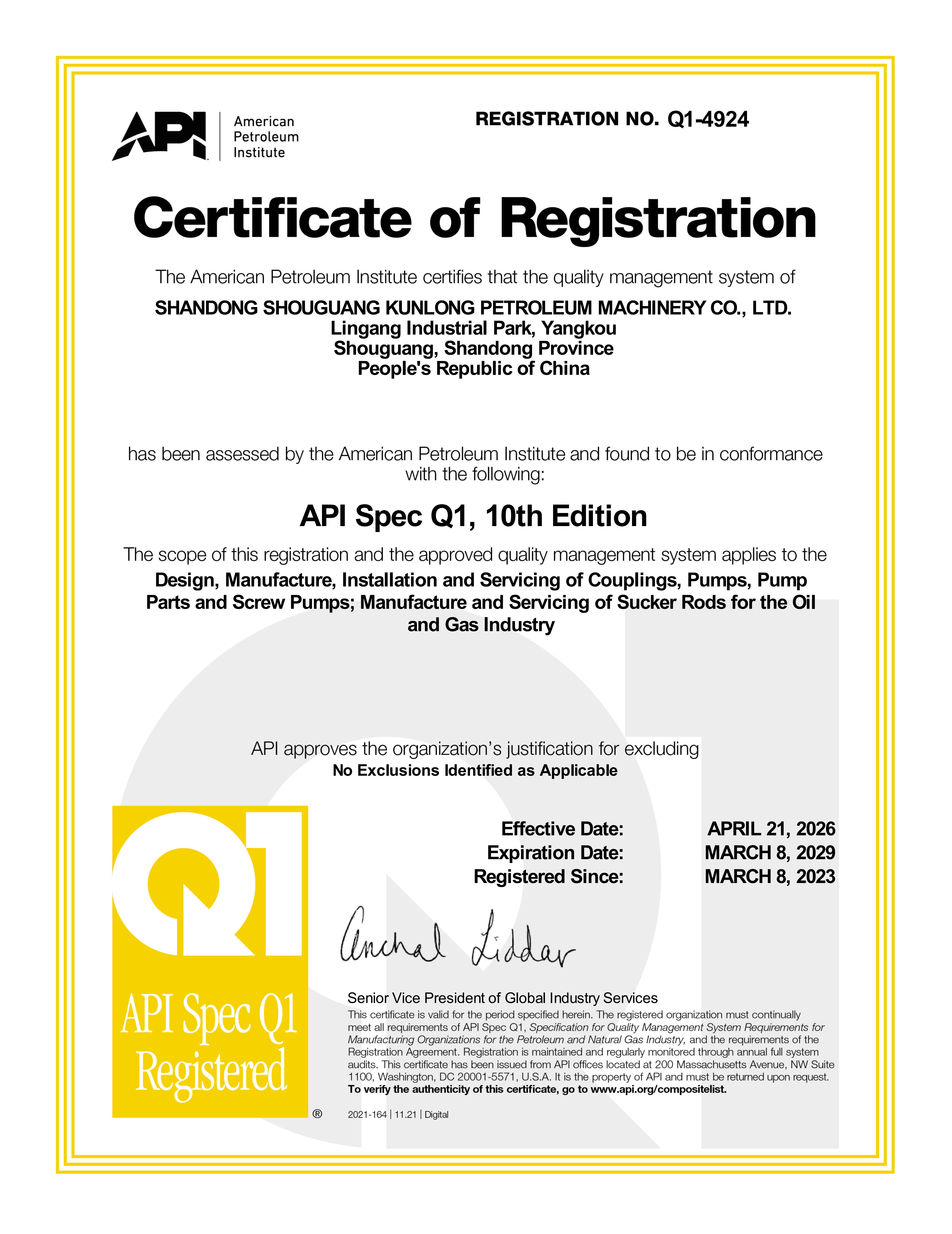
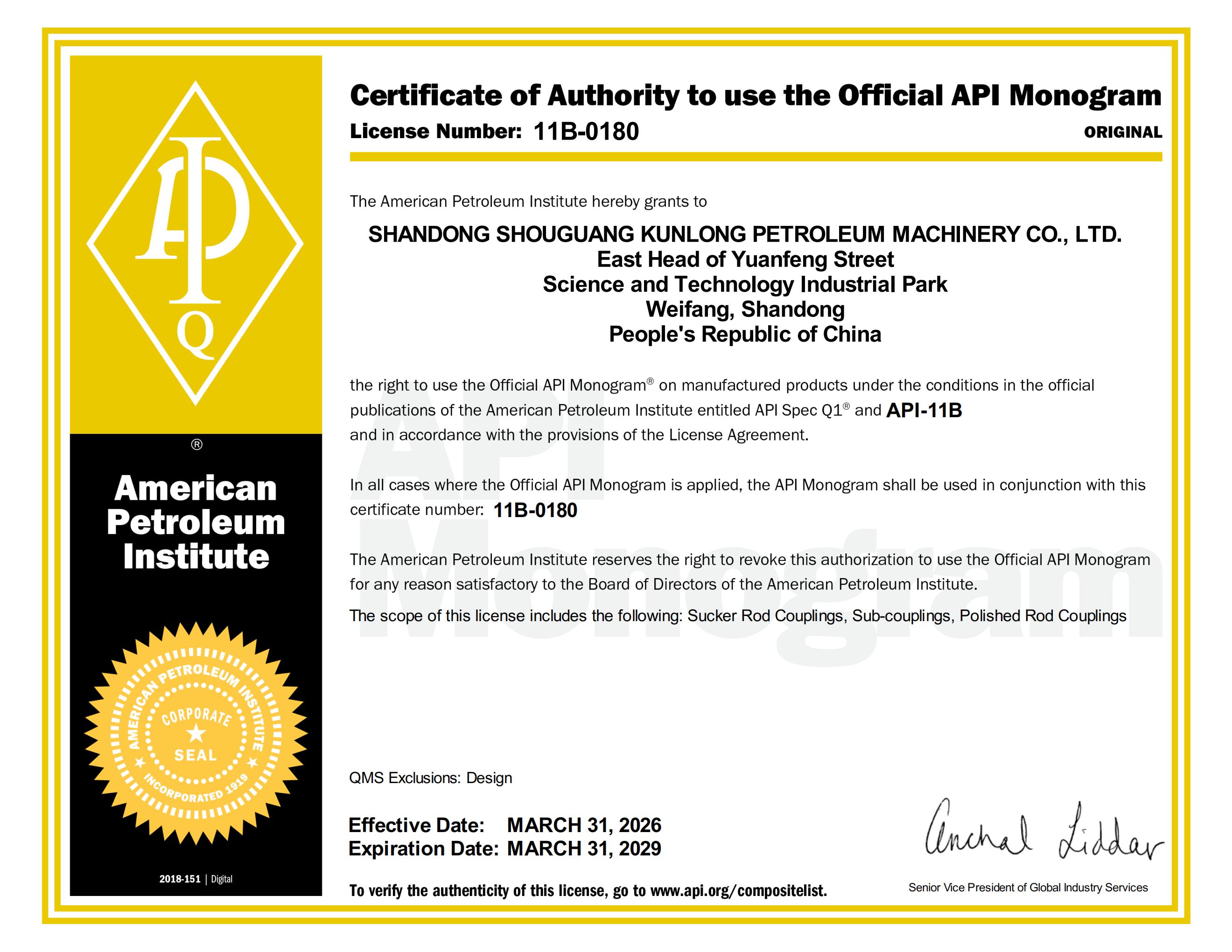
Kunlong holds API certification and registration for key artificial lift and rod string products. These certifications support LIU’s ability to provide products manufactured under recognized industry quality standards, with strong traceability, process control, and consistent production performance.
The API-certified product scope covers steel sucker rods, pony rods, polished rods, sinker bars, sucker rod couplings, sub-couplings, and polished rod couplings. This gives LIU a stronger foundation to support customers who require reliable rod string products manufactured under documented API quality systems and recognized oilfield production standards.
For operators, distributors, and service companies, API-certified manufacturing provides added confidence through controlled production procedures, material verification, machining consistency, inspection records, and repeatable batch quality.
In addition to standard API compliance, Kunlong continues to invest in production management, automated machining capability, inspection procedures, and process traceability to support long-term oilfield supply reliability. The manufacturing system includes controlled raw material sourcing, heat-treatment verification, precision thread processing, coating inspection, dimensional control, and batch tracking procedures designed to improve consistency across different product categories and delivery cycles.
API-11B License for Rod Products: Covers Sinker Bars, Polished Rods, Steel Sucker Rods, and Steel Pony Rods.
API-11B License for Couplings: Covers Sucker Rod Couplings, Sub-Couplings, and Polished Rod Couplings.
API Spec Q1 Registration: Covers the quality management system for couplings, pumps, pump parts, screw pumps, and sucker rods.
Documented Quality Control: Supports raw material verification, machining control, thread inspection, dimensional checks, coating control, and manufacturing consistency.
Supply Chain Confidence: Helps customers reduce sourcing risk and maintain stable quality across repeat orders, project procurement, and inventory stocking.
Built for Field Service: Products are designed for durability, fit accuracy, thread reliability, and dependable rod string performance.
LIU works with established manufacturing partners equipped with automated production lines, precision machining systems, coating facilities, and anti-corrosion processing capability to support stable sucker rod supply for oilfield customers.
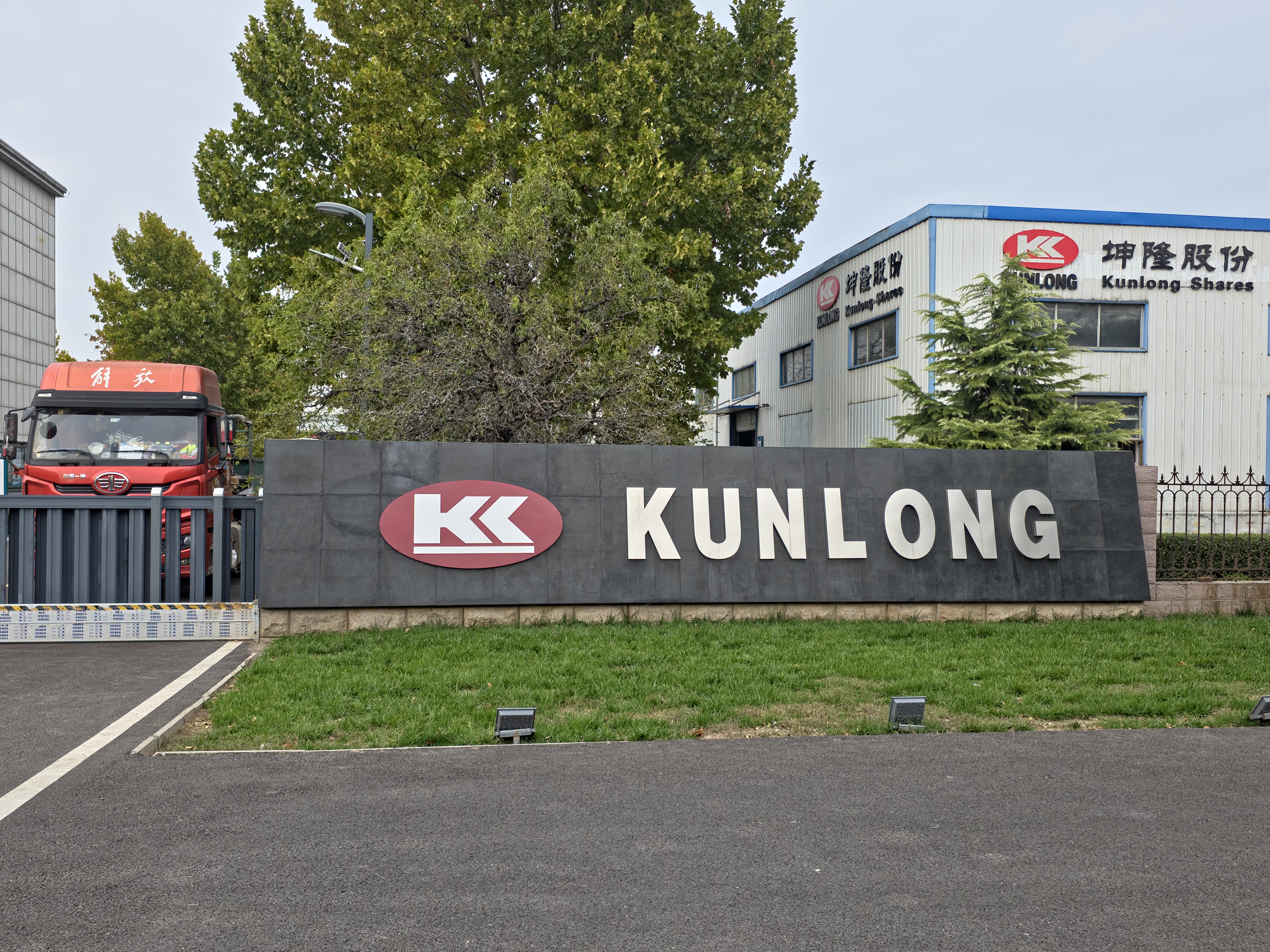
The Kunlong manufacturing facility serves as a centralized production base for sucker rods, polished rods, couplings, and related oilfield components, supporting stable large-scale supply capability.
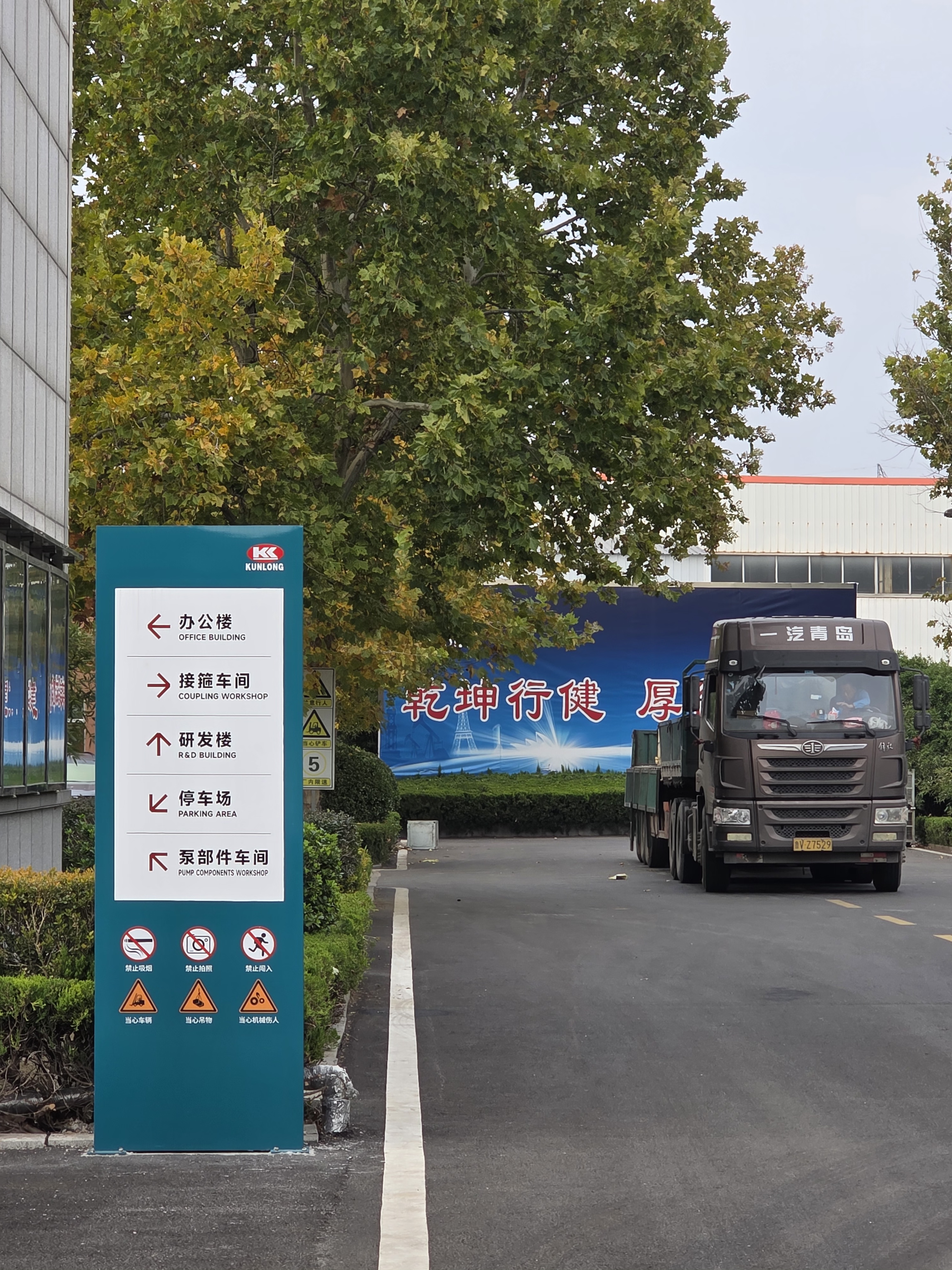
The Kunlong manufacturing facility operates as an integrated production base for sucker rods, polished rods, couplings, and key oilfield components, ensuring consistent quality control and reliable large-scale supply capability.
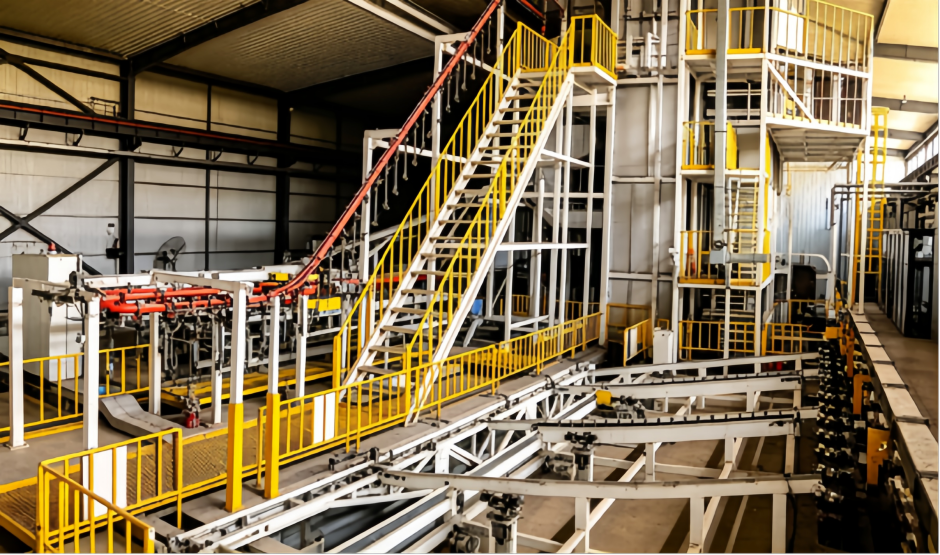
Automated surface coating capability for anti-corrosion sucker rod products used in corrosive, scaling, and waxing well conditions.
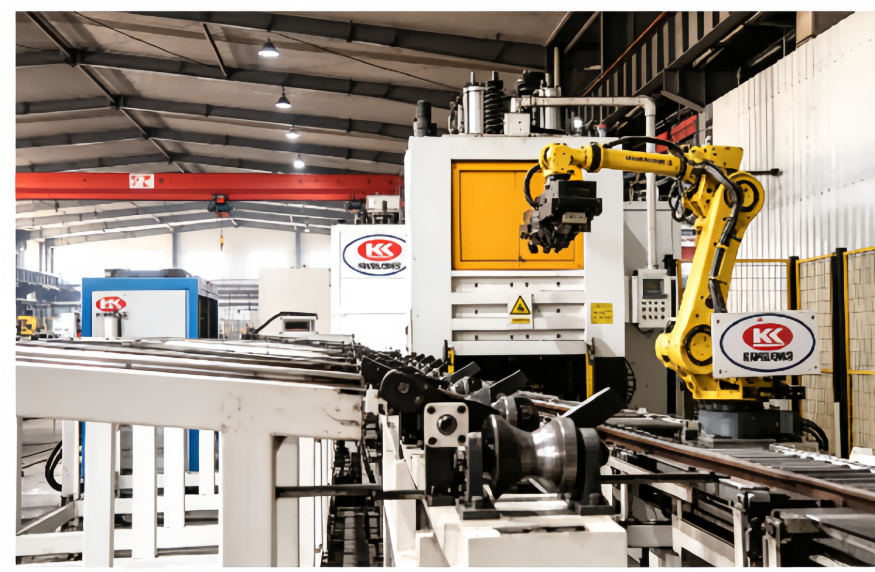
Controlled forging processes help improve dimensional consistency, end-forming quality, and repeatable production performance.
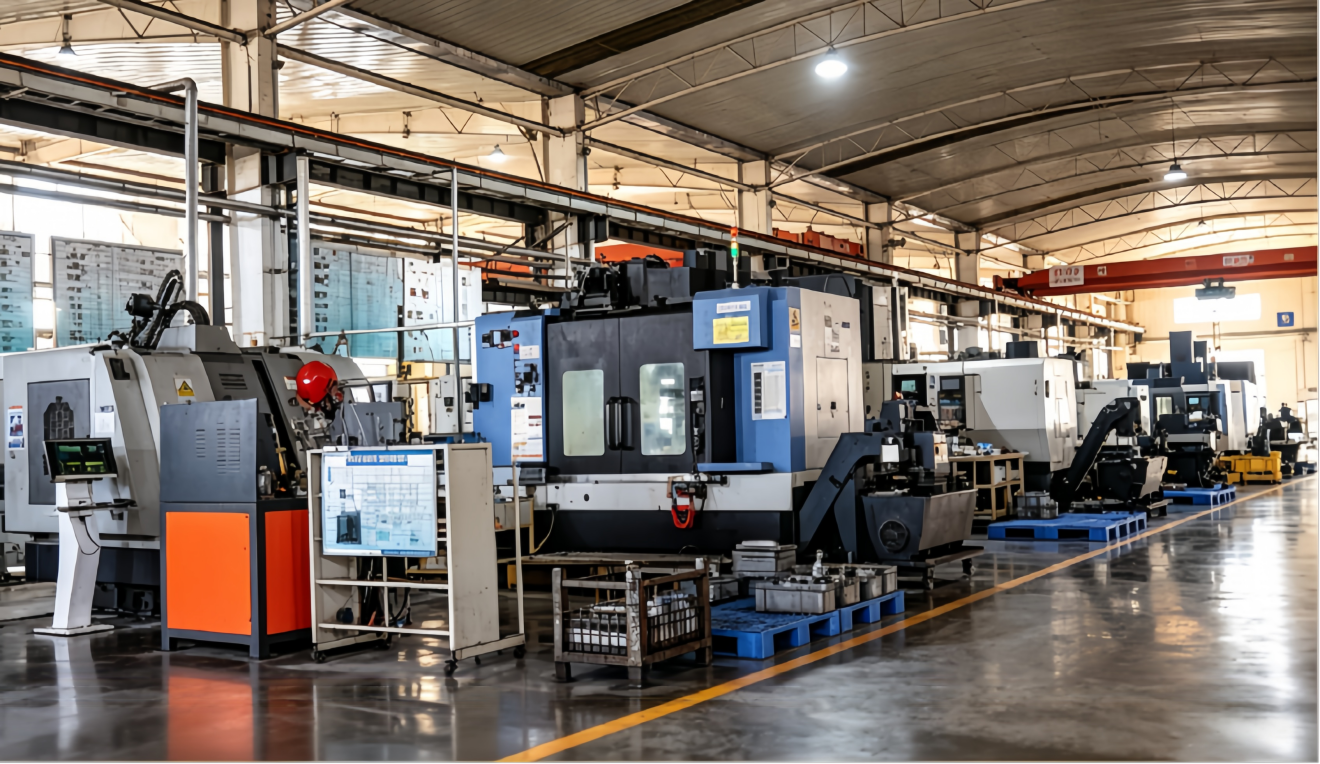
Imported turning centers support accurate machining of rod components, couplings, and connection-related parts.
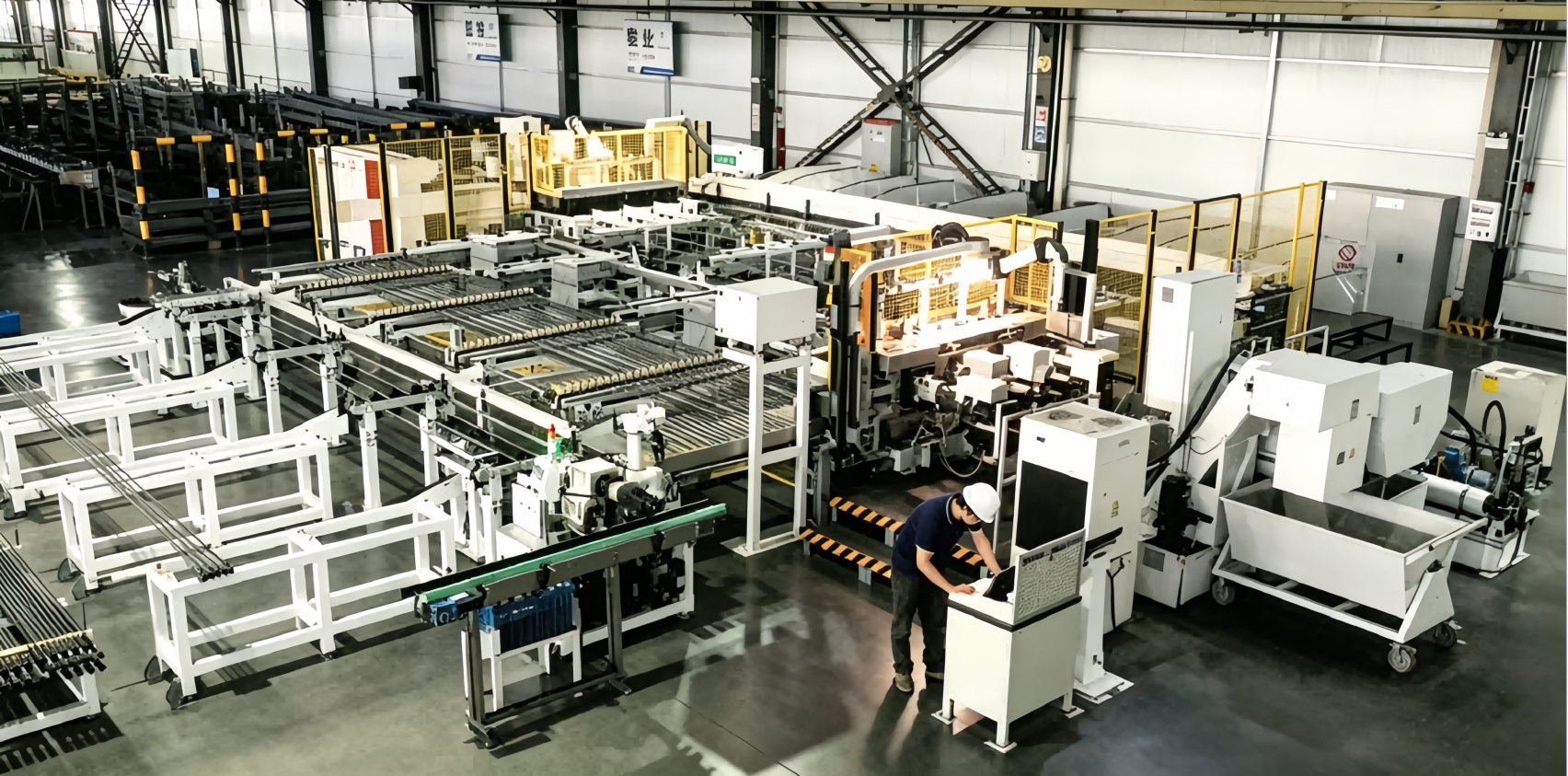
CNC thread processing helps maintain connection accuracy, assembly reliability, and rod string field performance.
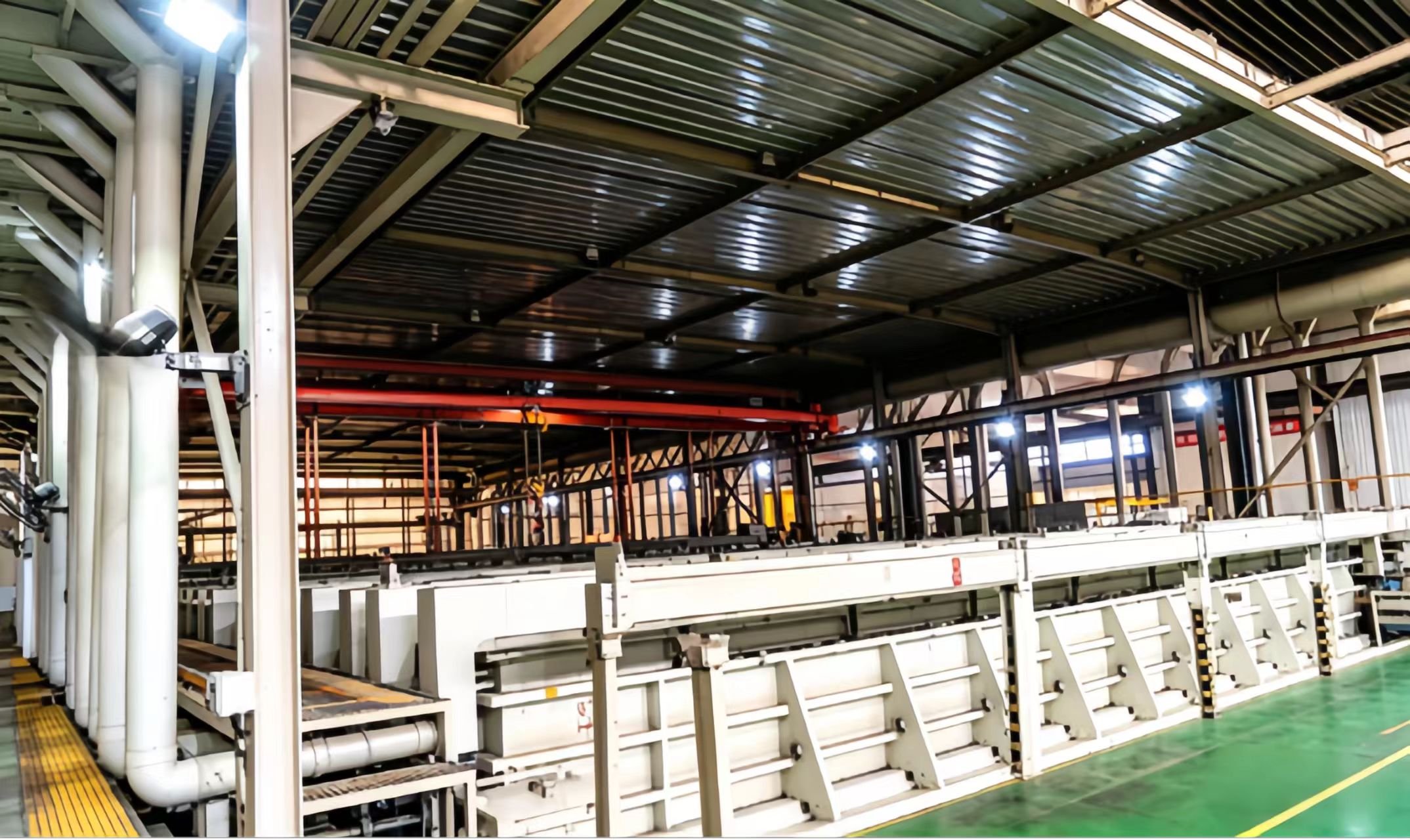
Specialized plating capability supports enhanced corrosion resistance, surface hardness, and longer service life in severe downhole environments.
Lift Innovation Universal supplies API-compliant sucker rods and pony rods engineered for reliable rod string performance in conventional, corrosive, deep, deviated, and heavy-load wells. Manufactured through our trusted API-certified production network, LIU rod products are designed to deliver strength, thread integrity, wear resistance, and long service life.
Available options include standard-grade sucker rods, high-strength rods, corrosion-resistant rods, tungsten-plated alloy rods, epoxy-coated rods, and specialty guide or wax-scraping rod products for challenging downhole applications.
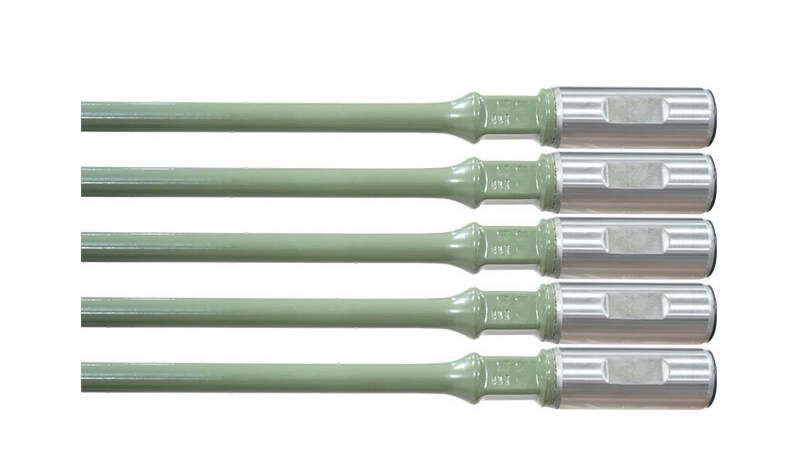
API-Compliant Design: Standard sucker rods and pony rods are manufactured to meet recognized API dimensional and performance requirements.
Reliable Thread Integrity: Precision thread processing and controlled forming help ensure stable connection strength and dependable field assembly.
Multiple Grades Available: Rod grades are available for medium-load, heavy-load, corrosive, and severe downhole conditions.
Flexible Rod String Matching: Pony rods are available in multiple lengths to support accurate rod string adjustment and pumping system optimization.
LIU supplies sucker rods for a wide range of artificial lift applications, from conventional production wells to deep and heavy-load pumping conditions.
Grade DA Rods: Designed for medium and heavy-load oil wells, using quality alloy steel and mature processing technology for stable field performance.
Grade DS Rods: Manufactured with corrosion-resistant alloy materials, suitable for general corrosive well environments where extended service life is required.
Grade HA / HS Rods: High-strength alloy rods for heavy and super-heavy load applications, deep wells, and demanding pumping conditions.
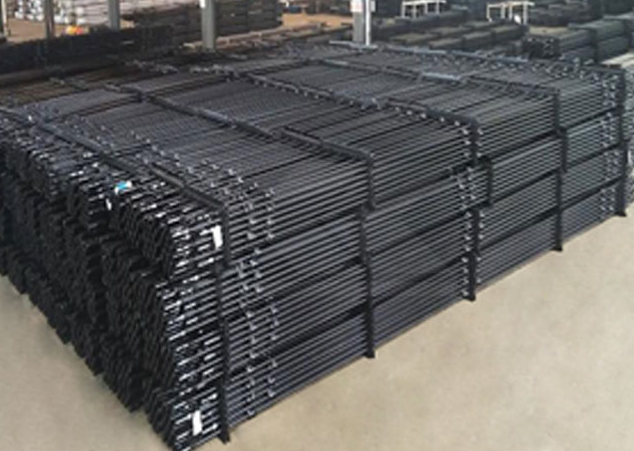
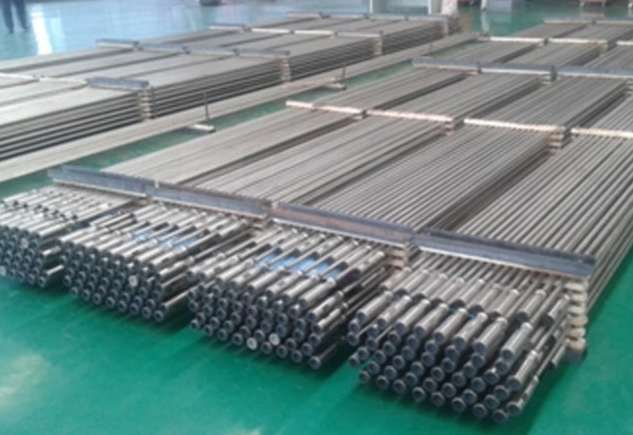
For corrosive and high-wear wells, LIU offers enhanced sucker rod options designed to improve rod life, reduce surface damage, and support more reliable production.
Tungsten-Plated Alloy Rods: A tungsten, nickel, and phosphorus alloy coating provides excellent hardness, wear resistance, and corrosion protection.
High Surface Finish: The smooth rod surface helps reduce wax and scale adhesion, lowering downhole friction and improving operating stability.
Severe Corrosion Service: Recommended for wells with hydrogen sulfide, carbon dioxide, and other highly corrosive production environments.
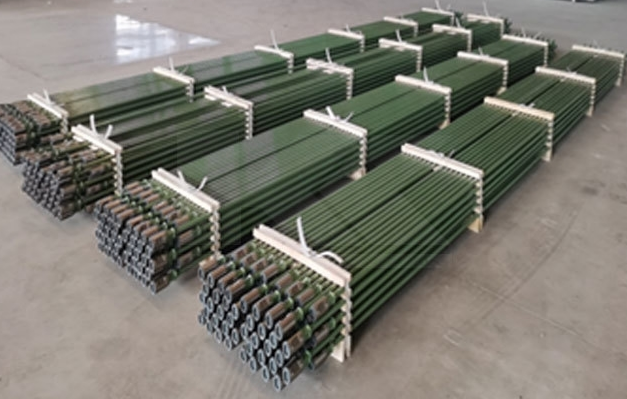
Epoxy-coated sucker rods are designed for wells where corrosion, scaling, waxing, and rod-body wear are common operating challenges.
Double-Layer Coating: Modified epoxy f coating helps form a dense protective barrier on the rod surface.
Improved Corrosion Protection: The coating helps protect the rod body from corrosive fluids and downhole chemical exposure.
Reduced Waxing & Scaling: Smooth coating surface helps reduce wax and scale buildup while lowering frictional resistance.
Recommended Applications: Suitable for complex wells with corrosion, abrasion, scaling, and waxing problems.
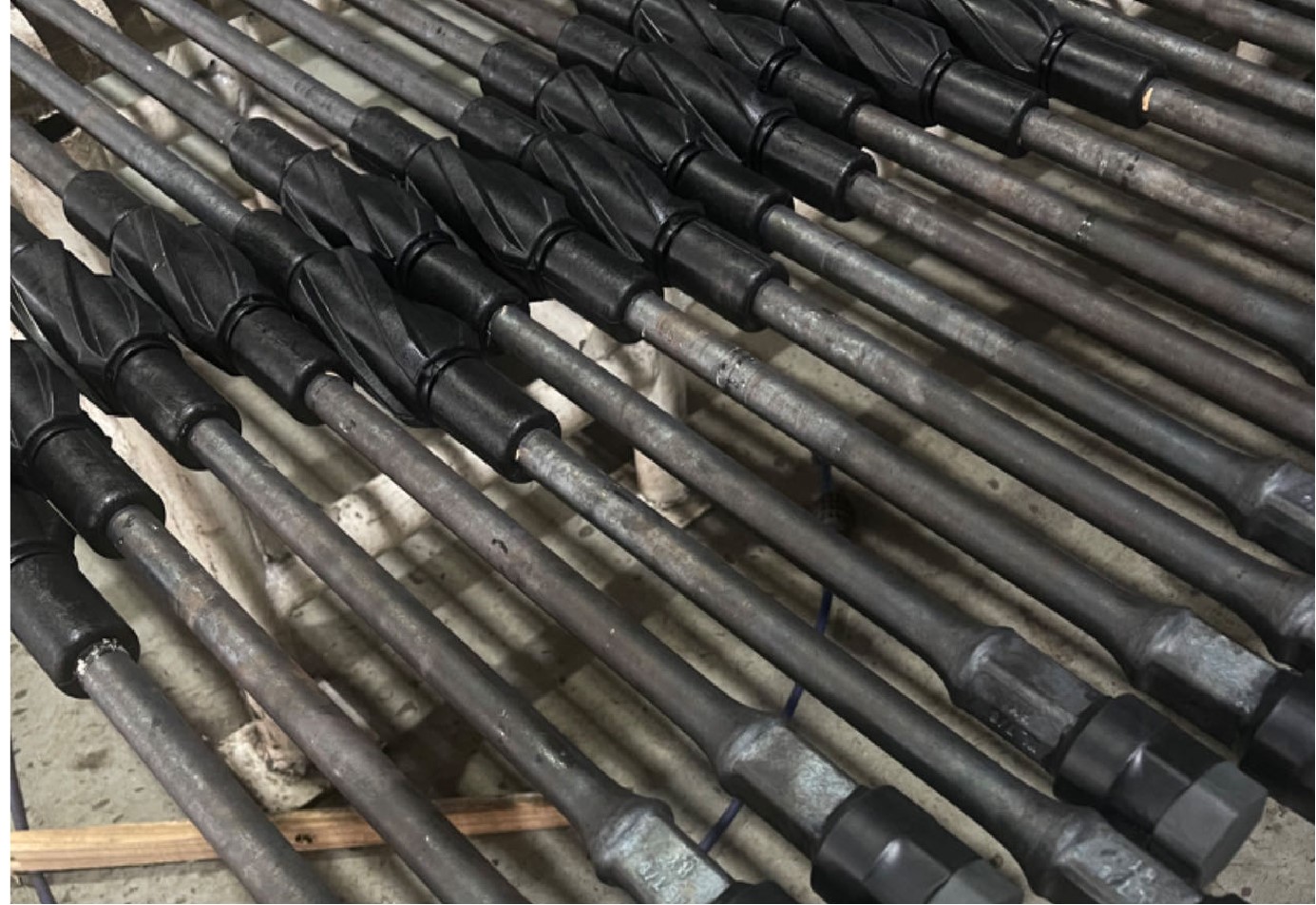
For deviated, directional, horizontal, and deep wells, LIU offers anti-deflection and wax-scraping sucker rod products designed to reduce tubing wear and improve rod string operation.
Spiral Guide Design: Helps centralize the rod string and provides effective wax-cleaning performance during operation.
Reduced Partial Wear: Freely rotating guide elements help distribute wear more evenly around the circumference.
Reinforced Nylon Material: High-strength guide components provide wear resistance and long service life.
Flexible Configuration: Guide quantity and placement can be adjusted based on well conditions and rod string design.
Standard sucker rod and pony rod dimensions are available in common oilfield sizes. Custom configurations may be supplied based on customer requirements, well conditions, and rod string design.
| Product | Common Sizes | Typical Lengths | Recommended Applications |
|---|---|---|---|
| Sucker Rod | 5/8", 3/4", 7/8", 1", 1 1/8" | 25 ft / 30 ft 8.0 m / 10.0 m |
Conventional pumping wells, medium-load wells, heavy-load wells, and general artificial lift applications. |
| Pony Rod | 5/8", 3/4", 7/8", 1", 1 1/8" | 2 ft, 4 ft, 6 ft, 8 ft, 10 ft, 12 ft 0.5 m to 4.0 m |
Rod string spacing adjustment, pump setting optimization, and precise rod string length matching. |
| Corrosion-Resistant Rod | Available by request | Standard or customized | Corrosive wells, CO₂/H₂S environments, scaling wells, waxing wells, and extended-life applications. |
| Guide / Wax-Scraping Rod | Matched to rod string design | Customized by application | Deviated wells, directional wells, horizontal wells, deep wells, and tubing wear reduction applications. |
For detailed dimensional requirements, grade selection, coating options, and delivery schedules, please contact Lift Innovation Universal with your rod size (OD x length), grade, material, tensile strength, yield strength, Coupling (if needed), quantity, and delivery location.
The following reference illustrations and tables summarize key dimensional elements, standard lengths, alternate metric lengths, material grades, mechanical properties, and requirements for steel sucker rods and pony rods.
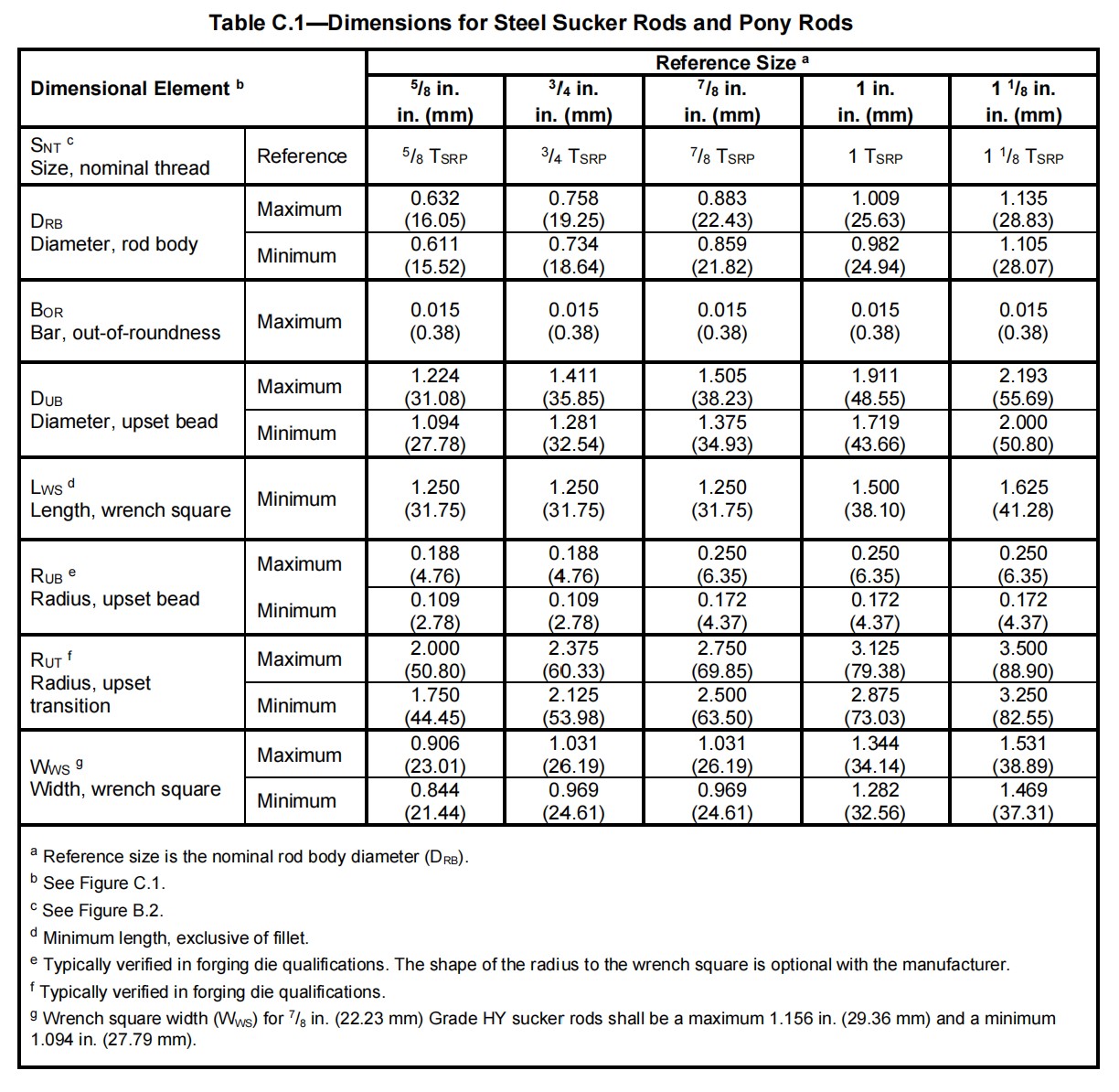
Dimensional reference covering common rod body diameters, upset bead dimensions, wrench square lengths, transition radii, and wrench square width requirements.
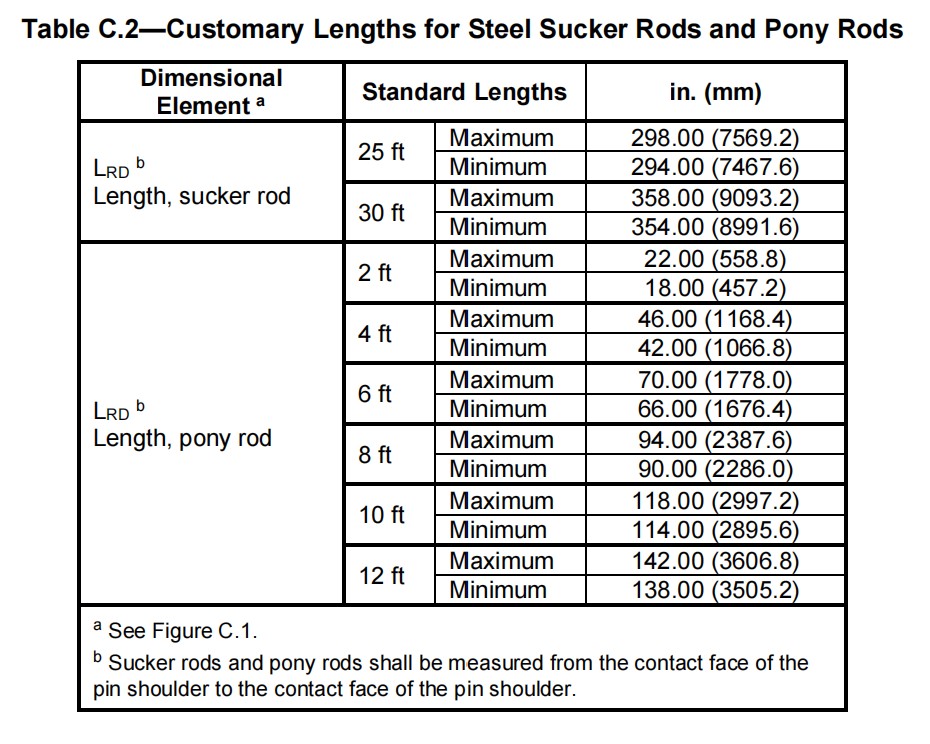
Standard length reference for sucker rods and pony rods, including commonly used field lengths such as 25 ft and 30 ft for sucker rods, along with pony rod lengths ranging from 2 ft to 12 ft. These standardized length options are widely applied in conventional pumping systems to support proper rod string configuration, optimize pump setting depth, and ensure accurate stroke alignment. Flexible pony rod length selection allows operators to fine-tune rod string spacing and achieve more efficient and reliable downhole performance across varying well conditions.
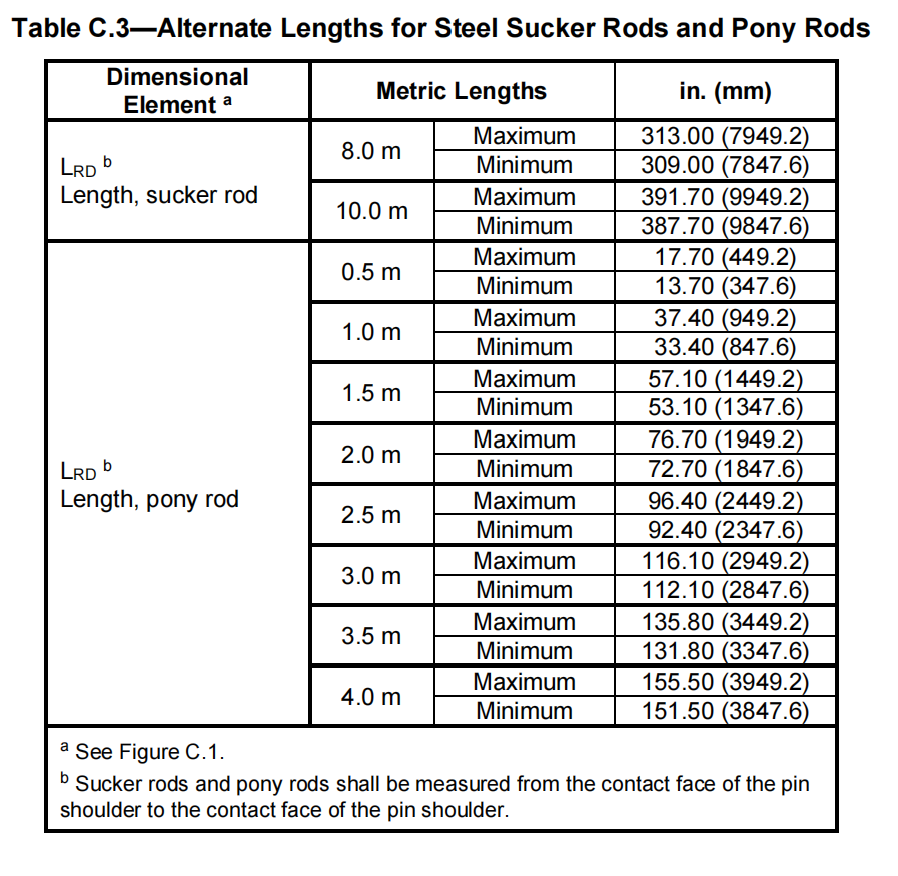
Metric length reference for sucker rods and pony rods, including 8.0 m and 10.0 m sucker rods, as well as pony rod lengths from 0.5 m to 4.0 m.
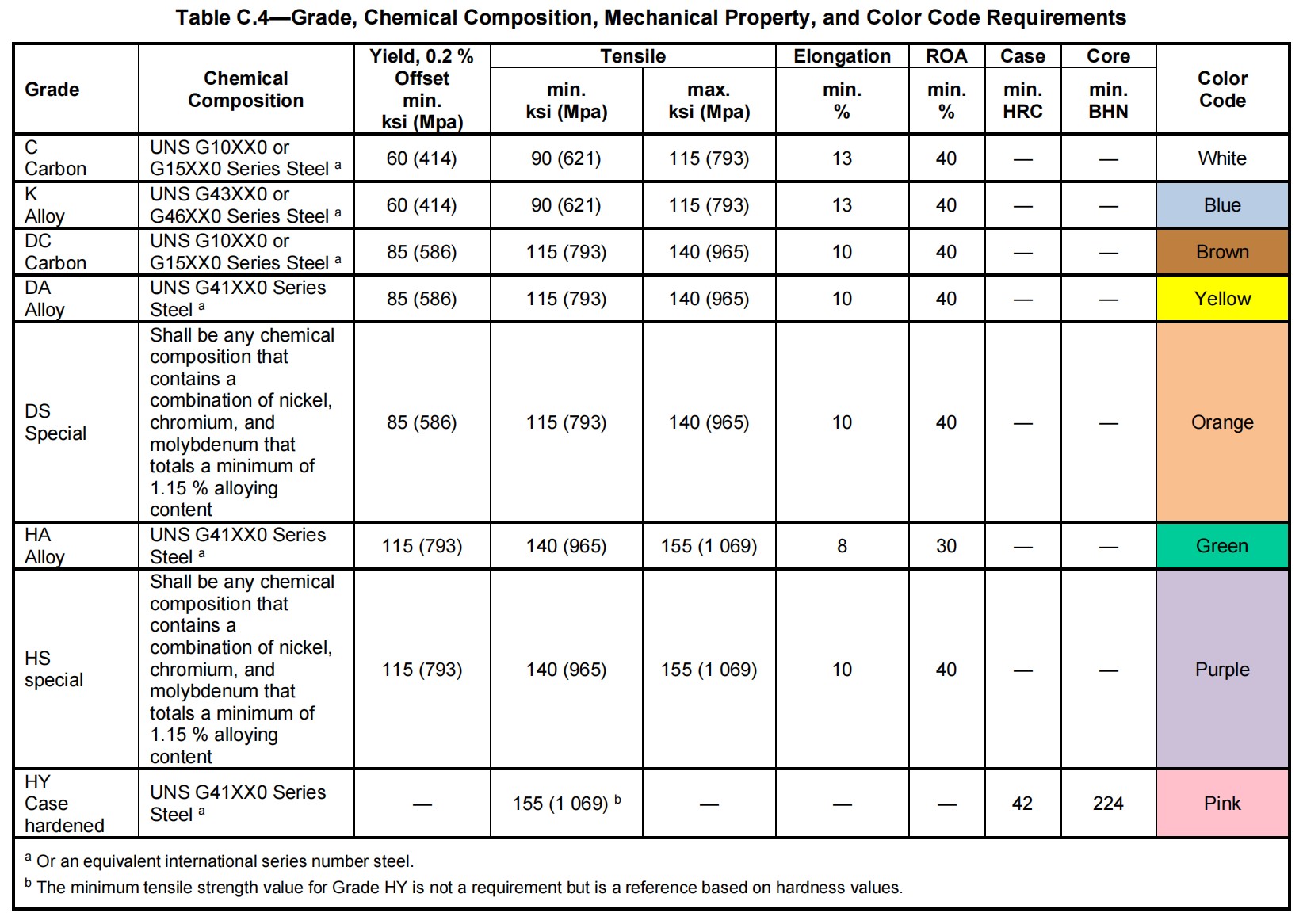
Reference table summarizing sucker rod grade classifications, chemical composition, yield strength, tensile strength, elongation, reduction of area, and color coding. These parameters define the mechanical performance characteristics and material properties of each rod grade, providing essential guidance for proper selection based on well depth, load conditions, and corrosive environments. The inclusion of standardized color coding also supports clear field identification and helps ensure correct rod usage, improving operational efficiency and reducing the risk of installation errors in rod string assemblies. These specifications align with recognized industry standards, supporting consistent quality control, traceability, and reliable performance across different manufacturing batches and field applications.
Lift Innovation Universal supplies API-compliant polished rods designed for reliable power transmission and effective wellhead sealing in rod pump systems. Manufactured in accordance with API 11B and related industry requirements, LIU polished rods are engineered to deliver high surface finish, dimensional accuracy, and consistent mechanical performance under a wide range of operating conditions.
Available options include plain polished rods, spray-metal alloy polished rods, and tungsten-plated polished rods, providing flexible solutions for conventional, high-wear, and corrosive well environments.
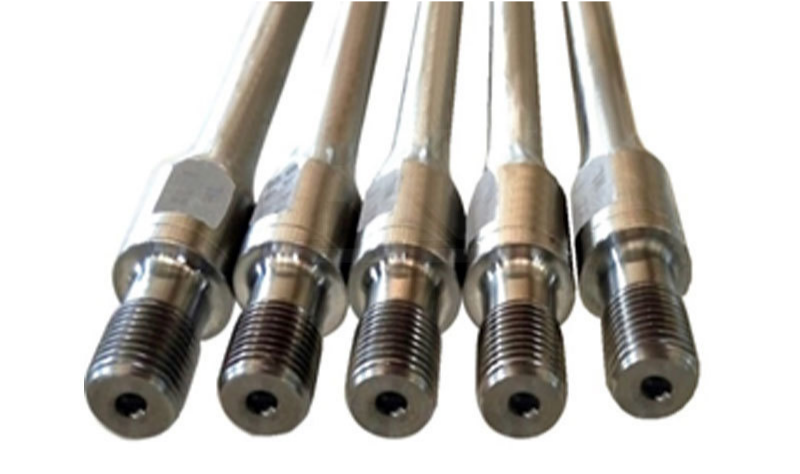
Plain polished rods are manufactured to meet API 11B requirements for structural dimensions and mechanical performance. The rod body features good straightness, precise roundness, and a smooth surface finish, helping reduce friction and wear at the stuffing box while maintaining reliable sealing performance.
High Surface Finish: Improves sealing efficiency and helps reduce packing wear during continuous reciprocating operation.
Dimensional Accuracy: Supports stable alignment between the rod string, stuffing box, and surface pumping equipment.
Reliable Field Performance: Suitable for standard rod pump lifting systems where conventional wear and corrosion conditions apply.
Recommended for common oil wells using rod pump lifting systems, serving both as a power transmission component and as the primary moving sealing surface at the wellhead.
Spray-metal alloy polished rods are produced using an automated thermal spraying and remelting process, forming a uniform alloy coating on the rod surface. This coating improves wear resistance and corrosion protection while maintaining the dimensional and mechanical performance required for polished rod service.
Wear-Resistant Alloy Coating: Helps reduce surface damage caused by packing friction and long-term reciprocating movement.
Improved Corrosion Protection: Helps protect the rod body in wells with moderate corrosive fluids and challenging surface sealing conditions.
Consistent Coating Quality: Automated spray-melting and remelting production supports uniform coating thickness and stable product quality.
Suitable for both conventional and moderately corrosive oil wells where operators require better durability, longer service life, and reduced maintenance compared with standard polished rods.
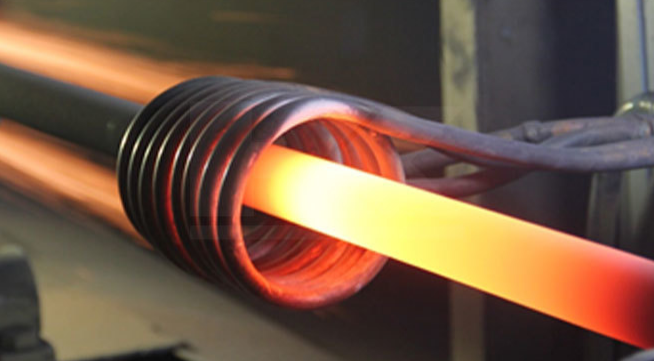
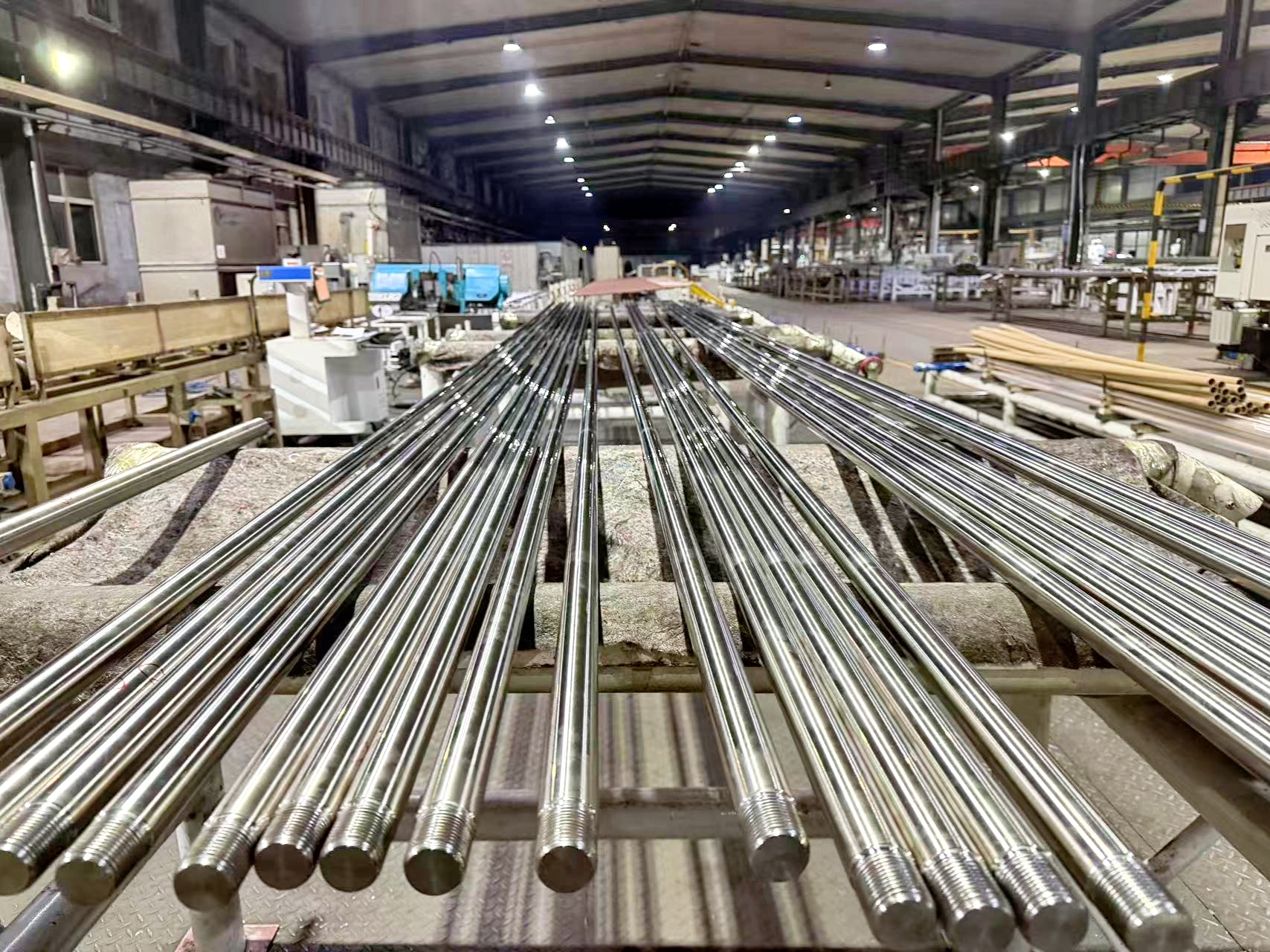
Polished rod performance depends not only on base material strength, but also on surface quality, straightness, coating uniformity, and finish consistency. Through controlled production and surface processing, LIU helps customers obtain polished rods suitable for stable sealing performance and repeatable field operation.
Controlled Surface Finish: A smooth rod surface helps improve packing contact and reduce sealing-related wear.
Batch Consistency: Stable production processes support repeat orders with consistent appearance, dimensions, and field usability.
Oilfield Supply Readiness: Available for operators, distributors, and service companies requiring dependable polished rod supply.
Tungsten-plated polished rods use a multi-alloy coating system composed of tungsten, nickel, and phosphorus to provide superior hardness, wear resistance, and corrosion protection. The dense coating structure creates a smooth, low-friction surface designed for demanding wellhead sealing and corrosive production environments.
High-Hardness Surface: Provides excellent resistance to wear, abrasion, and repeated contact with stuffing box packing.
Low Friction Coefficient: Helps reduce contact wear, improve sealing stability, and support smoother reciprocating operation.
Enhanced Corrosion Resistance: Suitable for environments containing hydrogen sulfide, carbon dioxide, chlorides, and high-salinity fluids.
Recommended for corrosive wells, high-mineralization wells, and severe service applications where standard polished rods may experience accelerated corrosion, surface damage, or shortened service life.
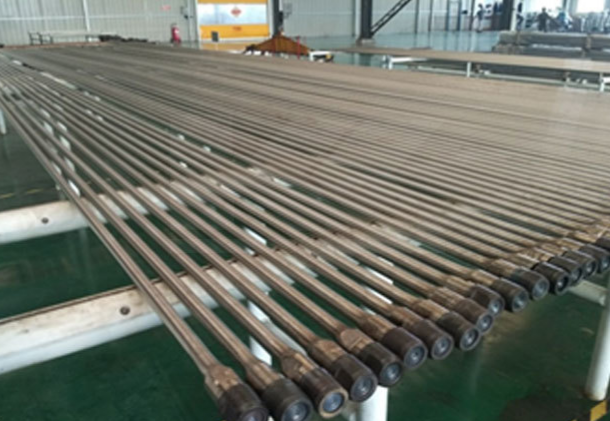
The following reference illustrations and tables summarize key dimensional elements, standard lengths, material grades, and mechanical properties requirements for polished rods used in rod pump lifting systems.
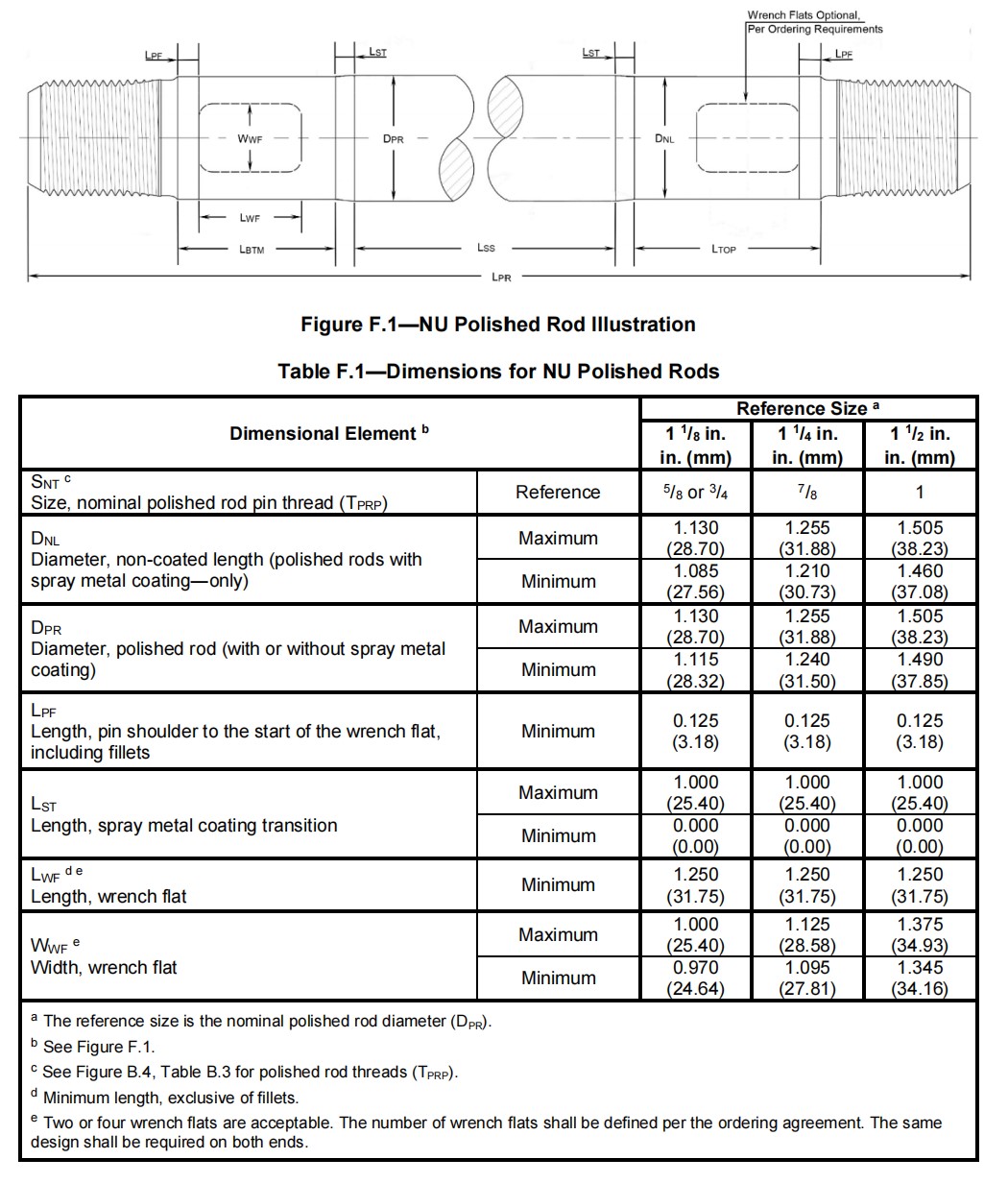
Dimensional reference for NU (Non-Upset) polished rods, including rod diameter, pin thread size, wrench flat dimensions, and coating transition areas. These specifications define the critical geometric parameters of the polished rod, ensuring proper fit and alignment within the rod string system and surface equipment. Accurate dimensional control helps maintain stable sealing performance at the stuffing box while reducing uneven wear during reciprocating operation. In addition, these standardized dimensions support interchangeability and compatibility across different equipment configurations, contributing to reliable power transmission and consistent field performance. Proper adherence to these dimensional requirements also facilitates installation, maintenance, and replacement in field operations, minimizing downtime and improving overall system efficiency.
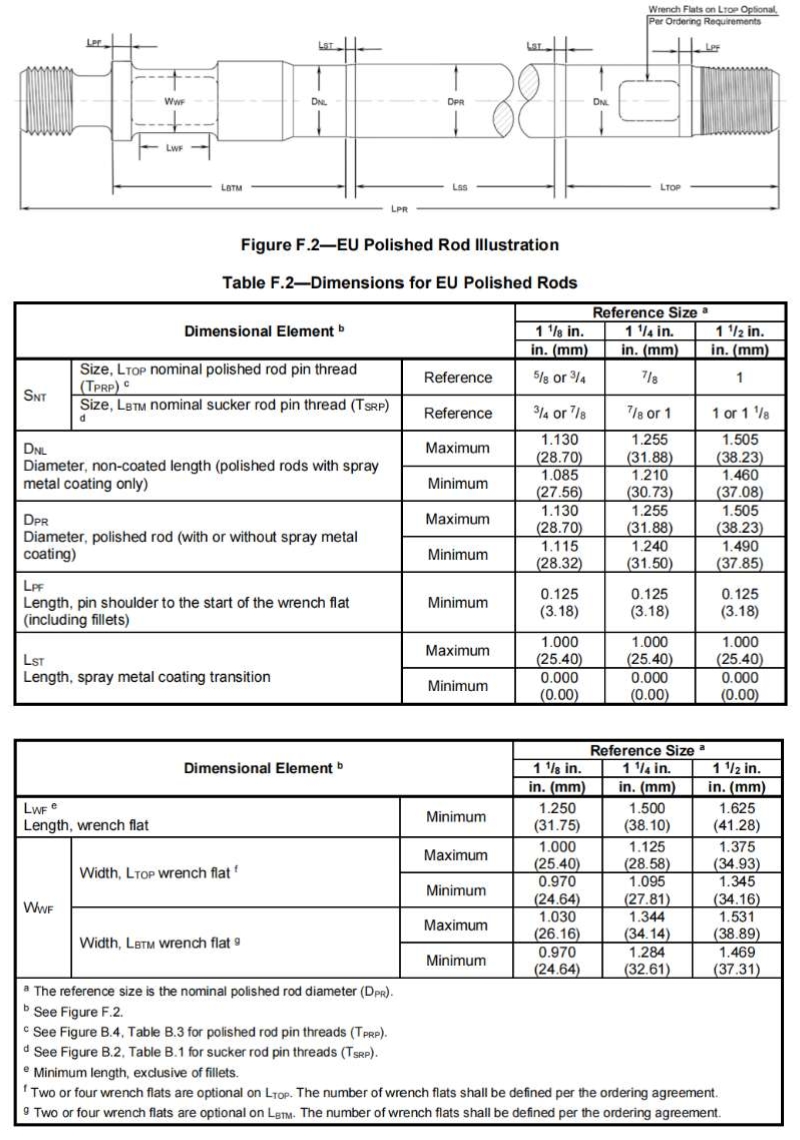
Dimensional reference for EU (External Upset) polished rods, covering upset geometry, wrench flat configuration, coating transition length, and rod body dimensions. These design features provide improved structural strength and enhanced durability for demanding operating conditions and high-load pumping systems.
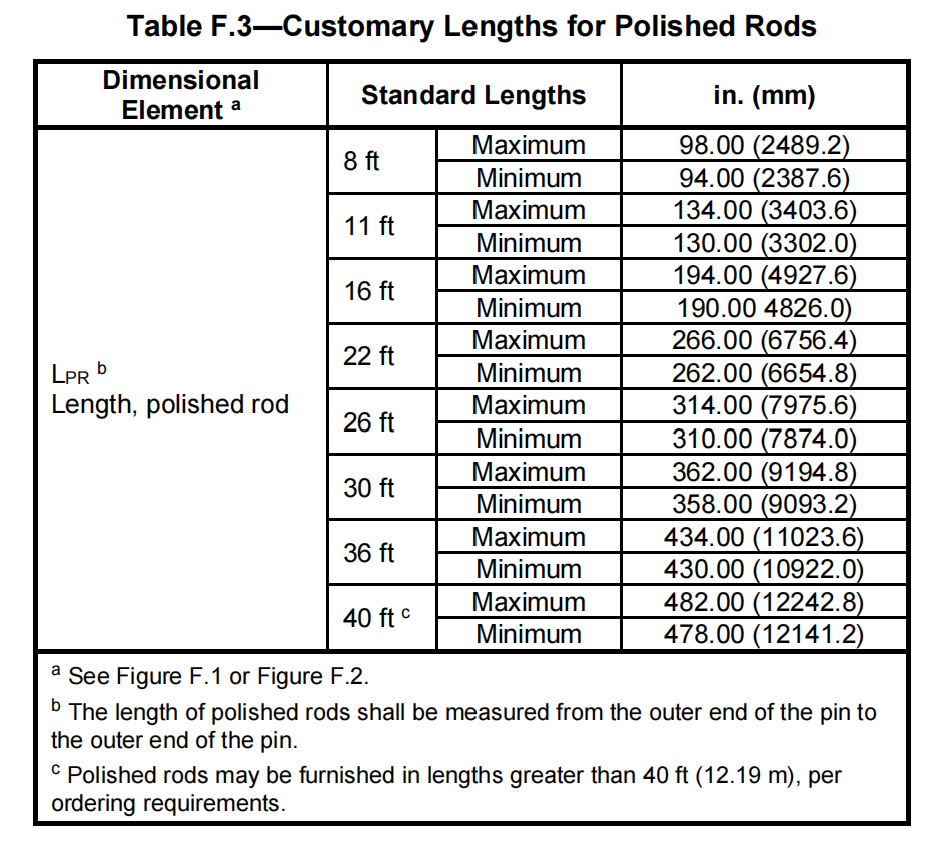
Standard length reference for polished rods, including commonly used field lengths such as 8 ft, 11 ft, 16 ft, 22 ft, 26 ft, 30 ft, 36 ft, and up to 40 ft. These length options are widely applied to match wellhead configuration, optimize stroke alignment, and ensure proper interface between the rod string and surface pumping unit.
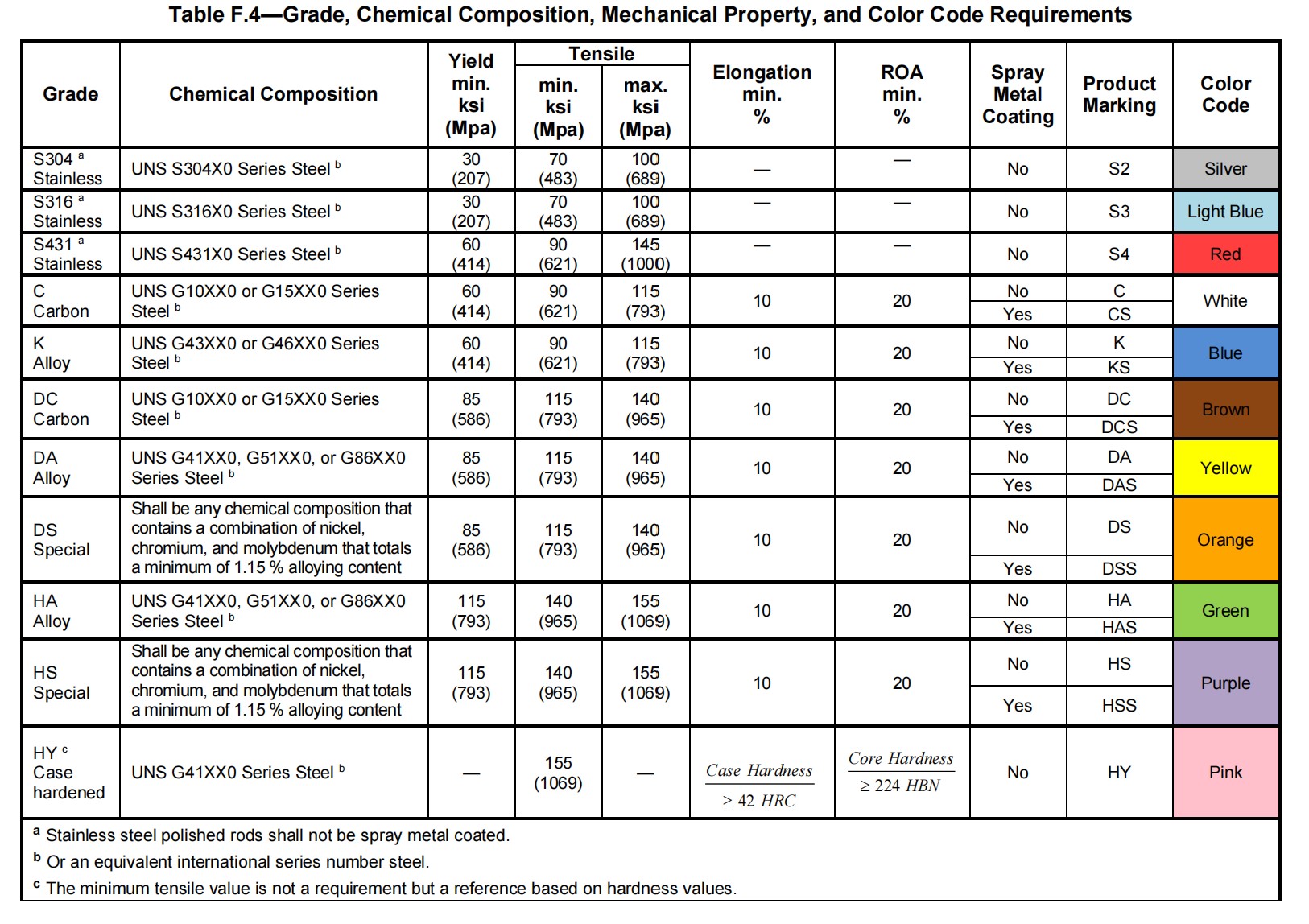
Reference table summarizing polished rod material grades, chemical composition, yield strength, tensile strength, and surface treatment options. These parameters define mechanical performance and corrosion resistance of each rod type, supporting proper selection for conventional, high-load, and corrosive well conditions. Standardized color coding enables clear field identification and reduces installation errors. In addition, material properties and surface treatment options provide flexibility in addressing operating challenges such as wear, scaling, and chemical exposure. By aligning with recognized industry standards, the table supports quality control, traceability, and reliable performance. It also assists engineers and operators in selecting suitable polished rod configurations to improve service life and overall system efficiency.
Lift Innovation Universal supplies API-compliant sucker rod couplings designed to provide secure, durable thread connections within rod string systems. Manufactured in accordance with API 11B requirements, LIU couplings are engineered for dimensional accuracy, surface quality, and consistent mechanical performance across a wide range of operating conditions.
Available options include standard TA couplings and spray-metal TAS couplings, offering reliable connection solutions for conventional wells, as well as enhanced wear and corrosion resistance for challenging downhole environments.
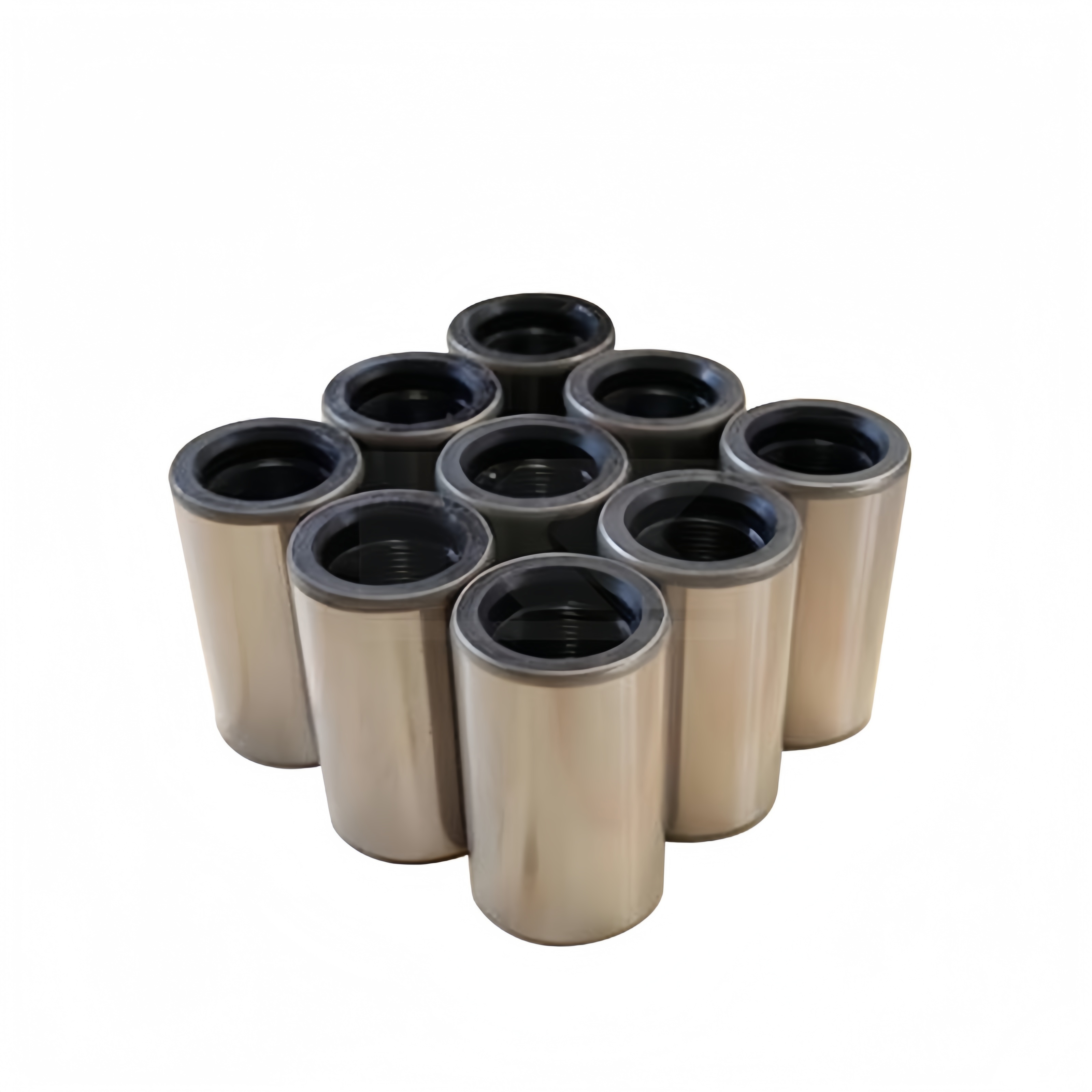
TA couplings are manufactured to meet API 11B dimensional and performance requirements, providing reliable thread connections for sucker rod systems in conventional oilfield applications. Available in full-size, slim-hole, and sub coupling configurations, these couplings are designed for compatibility across standard rod string assemblies.
Precision Machining: Automated processing supports accurate thread geometry, stable dimensions, and consistent connection quality.
Smooth Surface Finish: Helps reduce friction, improve assembly fit, and support reliable rod-to-rod connection performance.
Standard Field Application: Suitable for conventional wells where standard wear, load, and corrosion conditions apply.
Recommended for common rod pump lifting systems requiring dependable thread engagement, stable mechanical strength, and cost-effective connection performance.
TAS couplings are enhanced through a spray-metal coating process, applying Ni-based alloy material to the coupling surface to improve wear resistance and corrosion protection. The coating is applied through controlled production processes to support uniform surface quality and stable field performance.
Wear-Resistant Surface: Helps reduce damage caused by rod-to-tubing contact, side loading, and eccentric wear conditions.
Improved Corrosion Resistance: Provides added protection for wells with corrosive fluids and aggressive downhole environments.
Extended Service Life: Designed to reduce replacement frequency and improve reliability in demanding rod string applications.
Recommended for corrosive wells, eccentric wear wells, and applications where operators require stronger surface protection and longer service life than standard couplings.
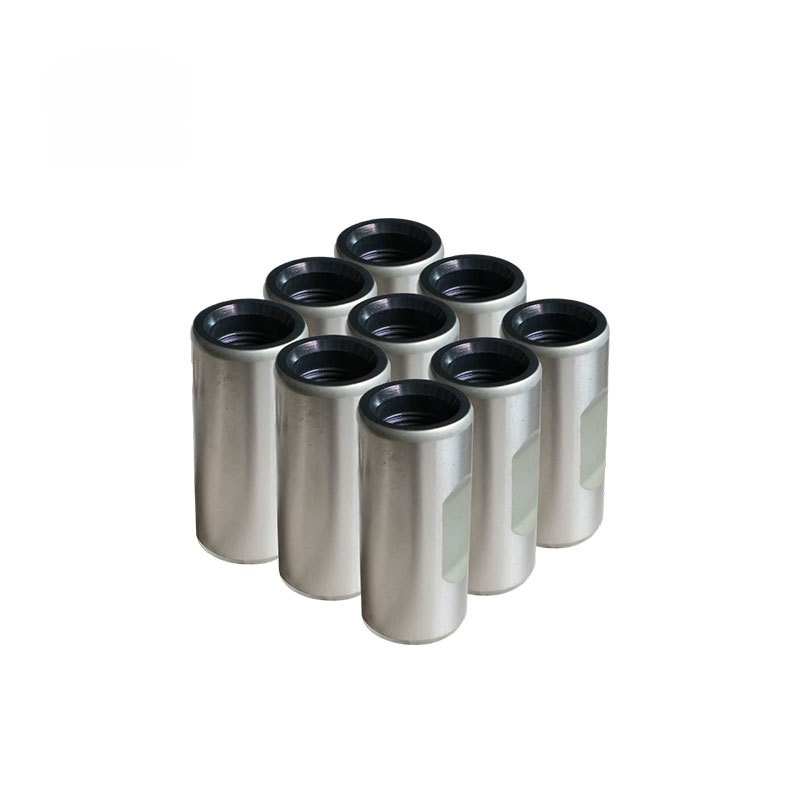
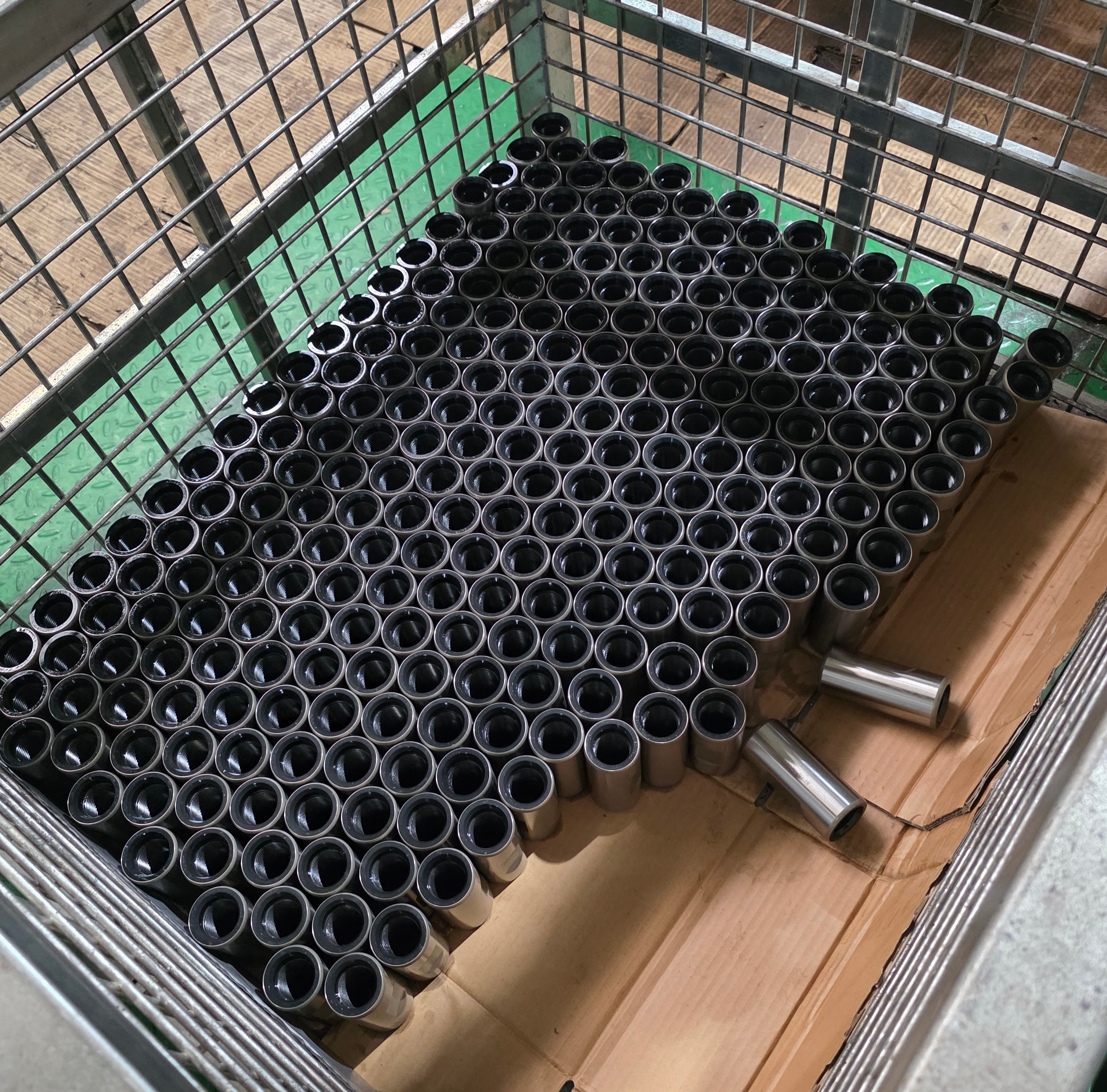
Coupling quality depends on precision threading, stable dimensional control, surface finish, and reliable batch consistency. Through automated machining and controlled inspection processes, LIU supports dependable coupling supply for operators, distributors, and service companies requiring repeatable product quality. Strict process control and standardized production workflows help ensure that each coupling meets consistent dimensional and performance requirements across different batches and delivery cycles.
Batch Consistency: Stable production processes help maintain uniform dimensions, thread quality, and surface appearance across repeat orders.
Rod String Compatibility: Couplings are designed to match standard sucker rod configurations and support proper field assembly.
Supply Chain Confidence: Suitable for inventory stocking, project-based procurement, and long-term oilfield service support.
Whether for standard operations or severe downhole environments, LIU couplings provide secure thread engagement, reliable performance, and cost-effective rod string connection solutions, supporting efficient installation, reduced downtime, and long-term operational stability.
The following illustrations and reference tables summarize common coupling structures, dimensional requirements, thread connection configurations, material grades, mechanical properties, spray-metal coating options, and product marking requirements for sucker rod couplings and sub-couplings.
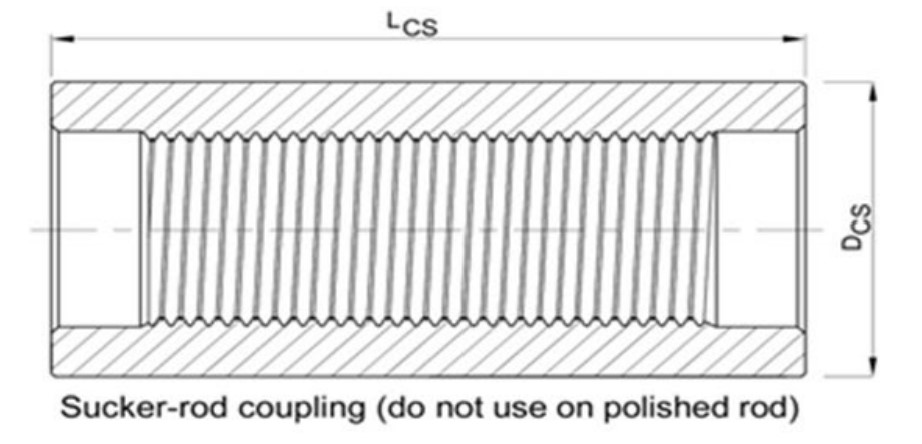
Basic structural reference for sucker rod couplings, showing coupling length, outside diameter, internal thread profile, and connection geometry used for standard rod-to-rod connections. This configuration is intended for sucker rod applications and should not be used on polished rods.
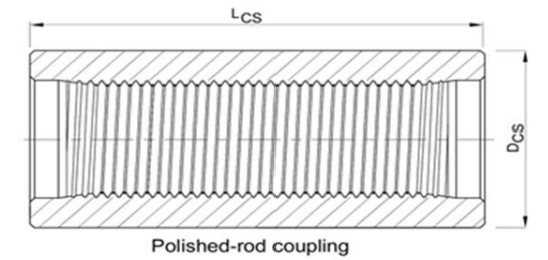
Structural reference for polished rod couplings, showing the internal thread arrangement and dimensional elements required for polished rod connection service. This design supports proper fit, reliable thread engagement, and compatibility with polished rod assemblies used at the wellhead.
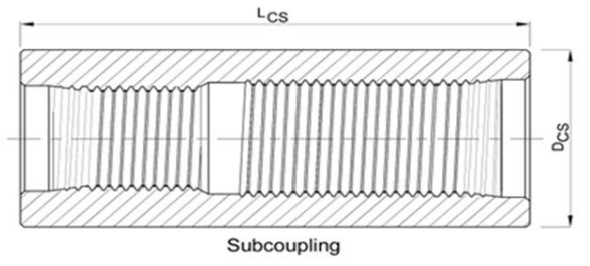
Structural reference for sub-couplings used to connect different thread sizes within rod string systems. The offset internal thread configuration enables transition between selected rod or polished rod sizes while maintaining secure engagement and proper axial alignment.
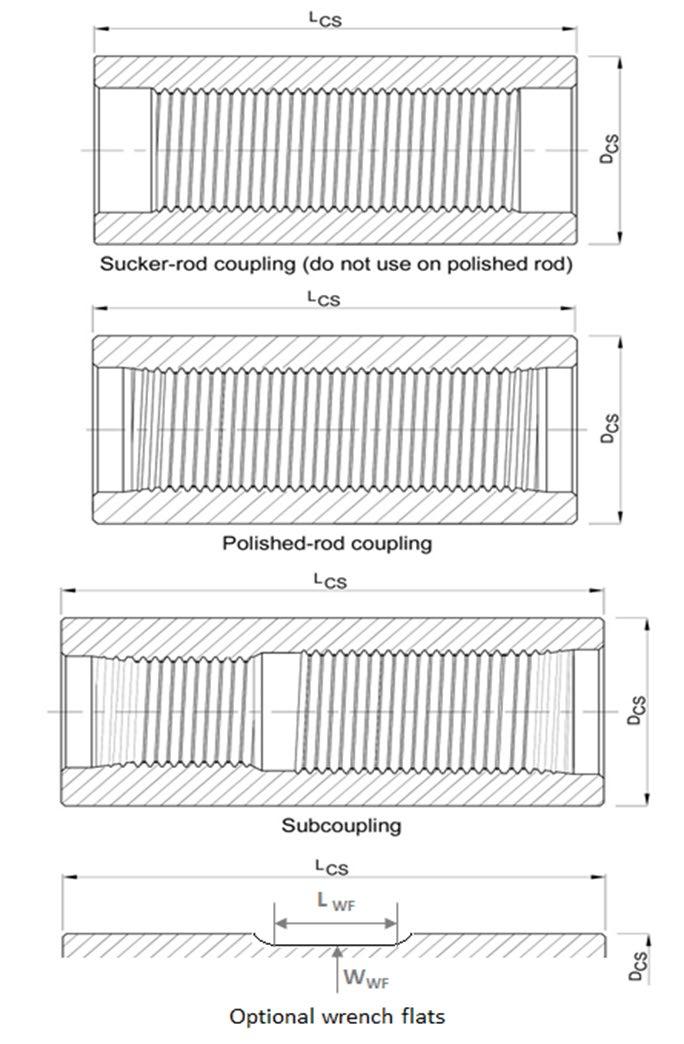
Overview illustration comparing sucker rod coupling, polished rod coupling, sub-coupling, and optional wrench flat configurations. This drawing helps identify the correct coupling type for rod string assembly, field replacement, and special ordering requirements.
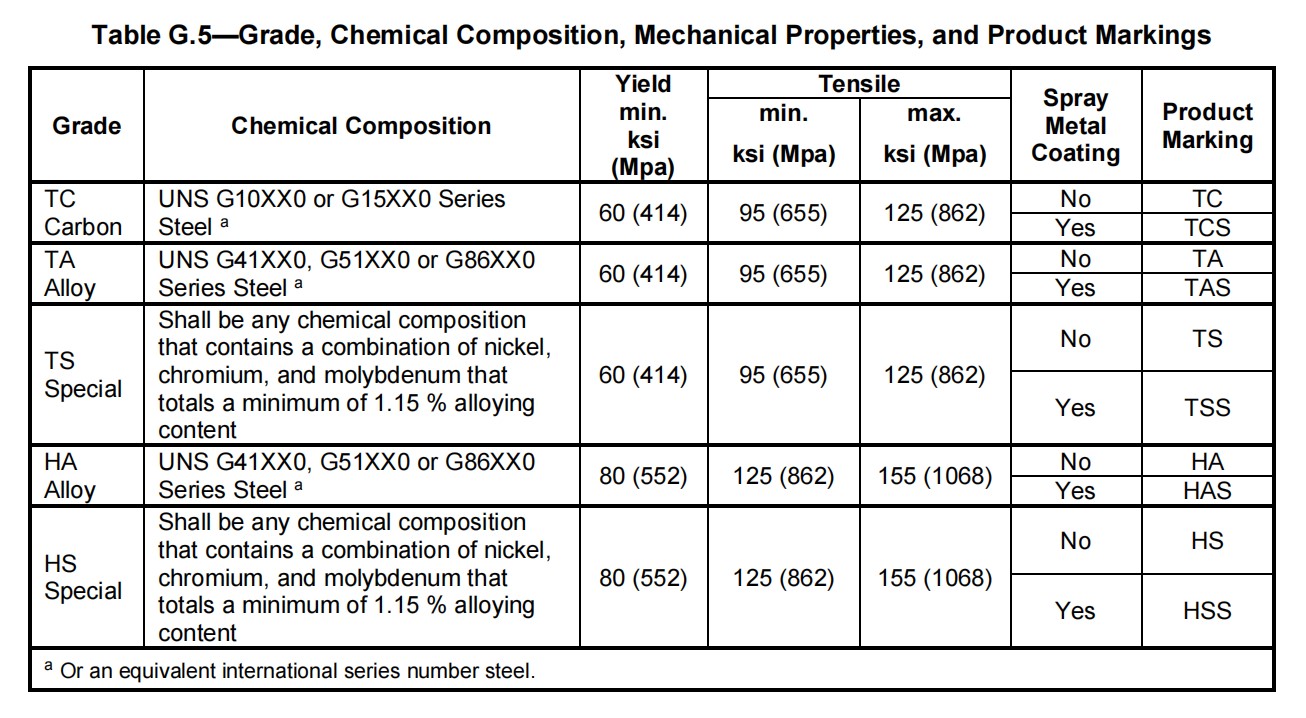
Reference table summarizing coupling material grades, chemical composition, yield strength, tensile strength, spray-metal coating availability, and product marking requirements. These parameters support proper coupling selection for standard, high-load, corrosive, and wear-prone rod string applications while maintaining traceability and field identification.
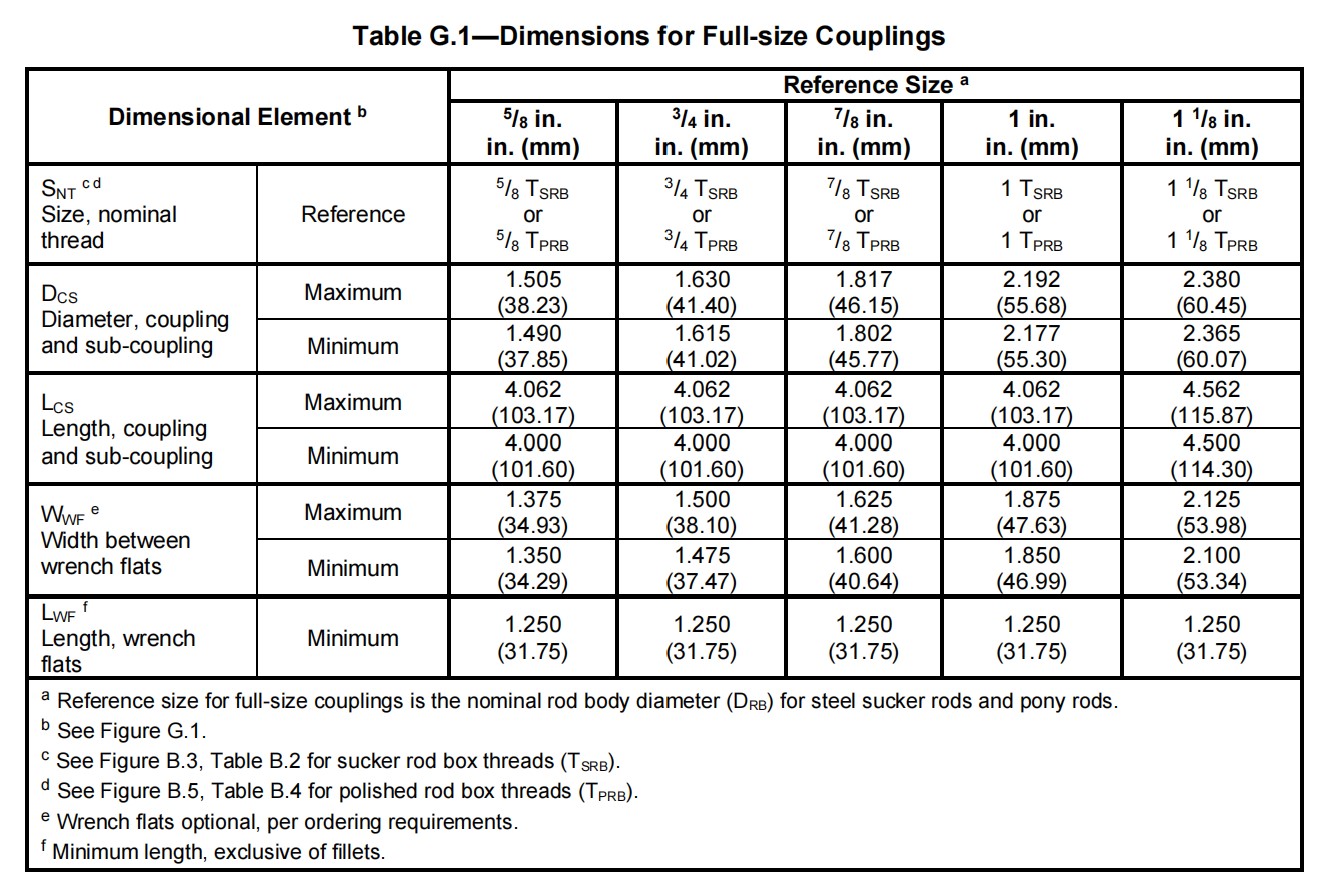
Dimensional reference for full-size couplings, including nominal thread size, coupling diameter, coupling length, and optional wrench flat dimensions. These specifications support proper matching with standard sucker rods, polished rods, and related rod string components.
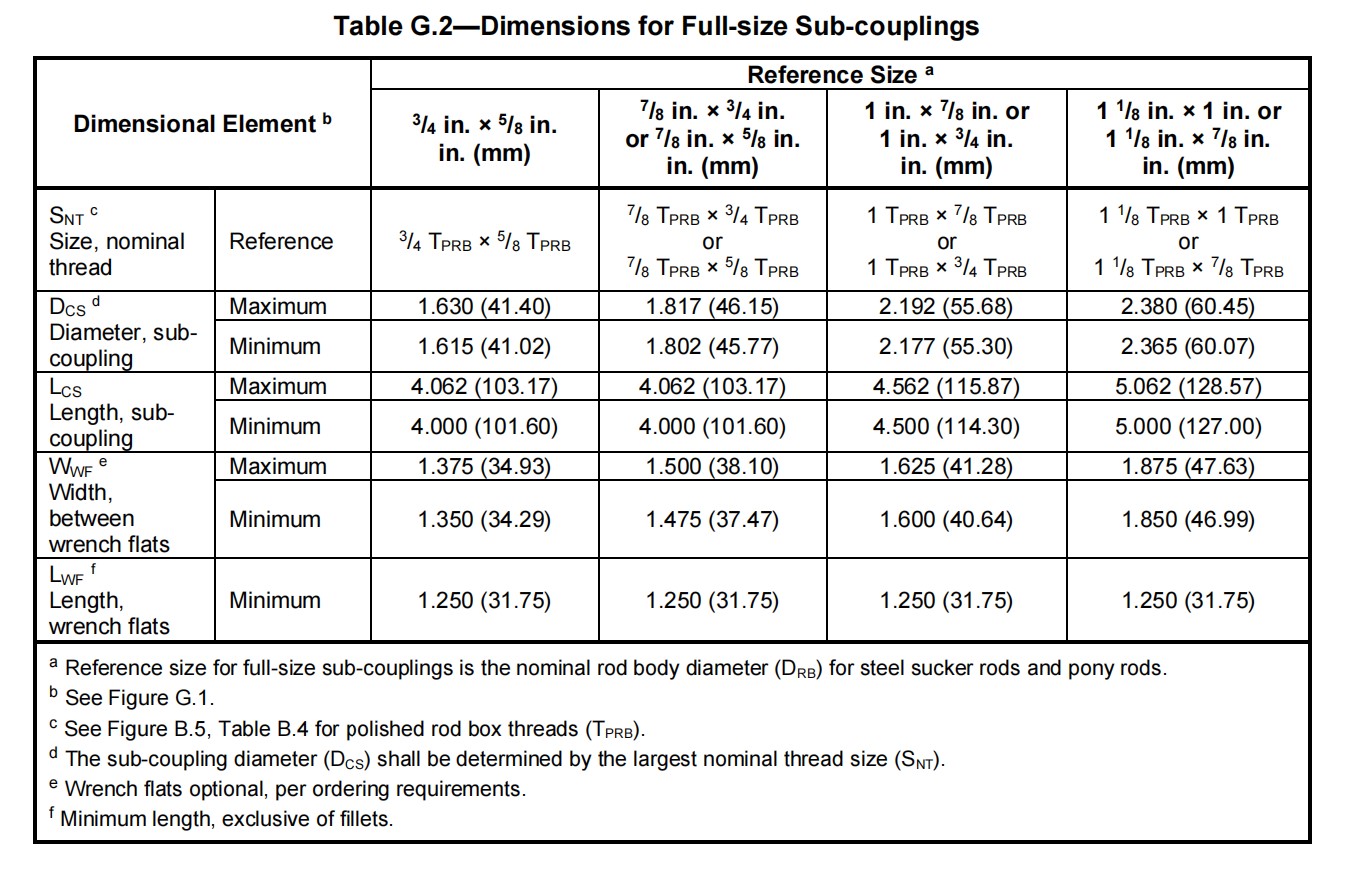
Dimensional reference for full-size sub-couplings used to connect different nominal thread sizes within a rod string. These tables help define diameter, length, wrench flat dimensions, and thread combinations for transition connection applications.
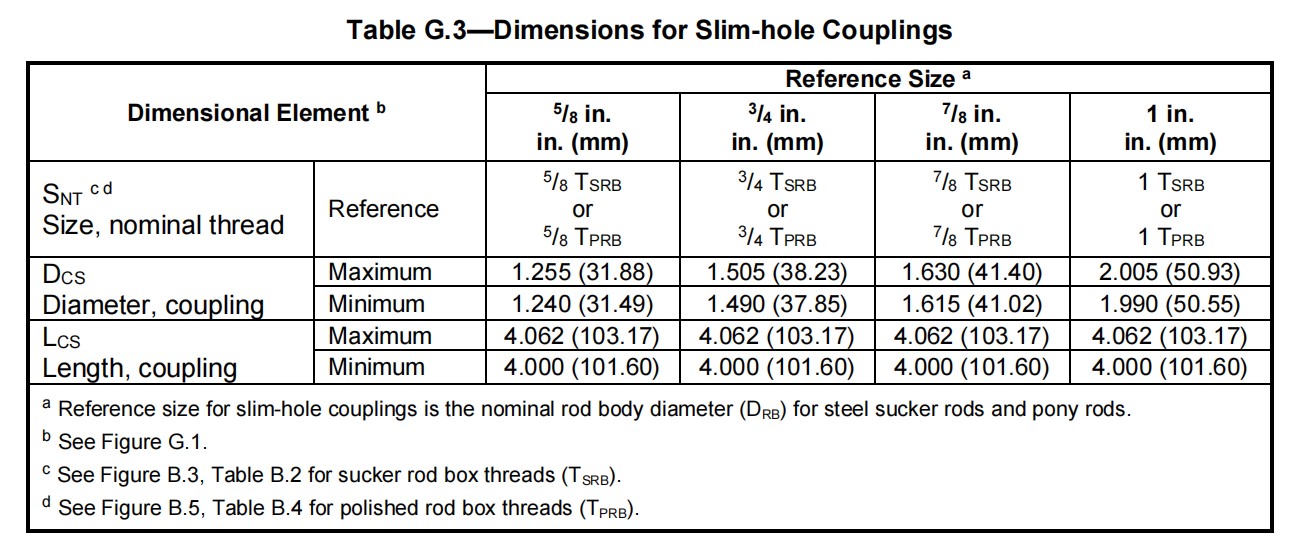
Dimensional reference for slim-hole couplings designed for reduced outside diameter applications. These couplings are commonly considered where clearance is limited, helping support rod string operation in wells with tighter tubing or special downhole configuration requirements.
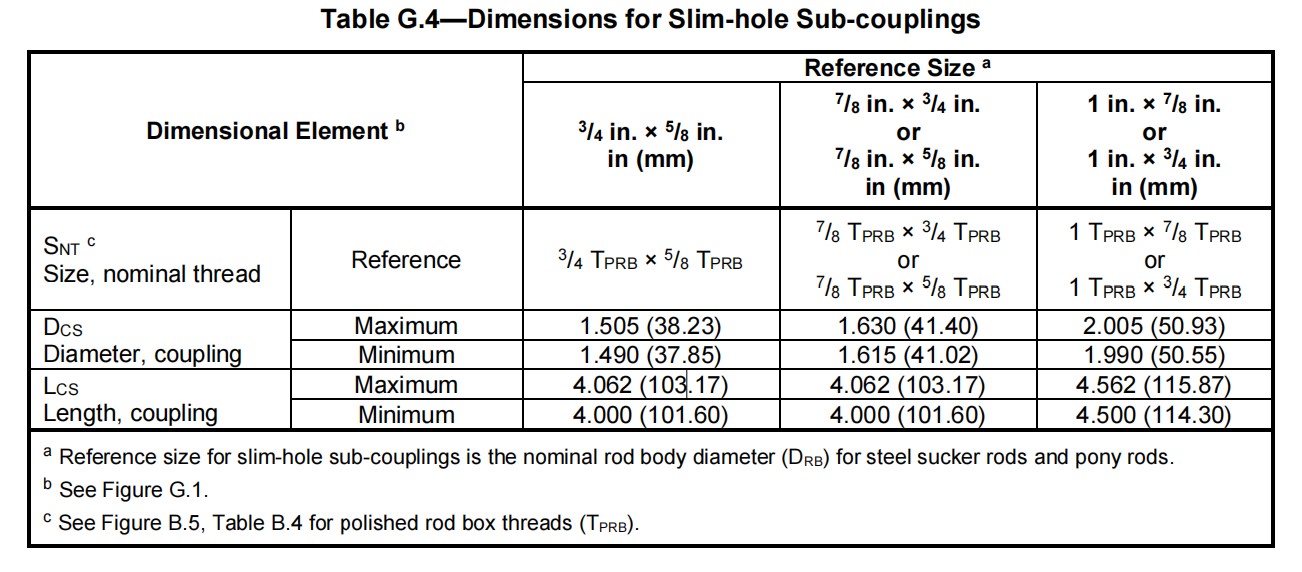
Dimensional reference for slim-hole sub-couplings used in transition connections where reduced outside diameter is required. These specifications help match selected thread combinations while supporting installation in limited-clearance well conditions.